This article was translated from German. Despite our care, some technical terms may be imprecise. The German version is authoritative.
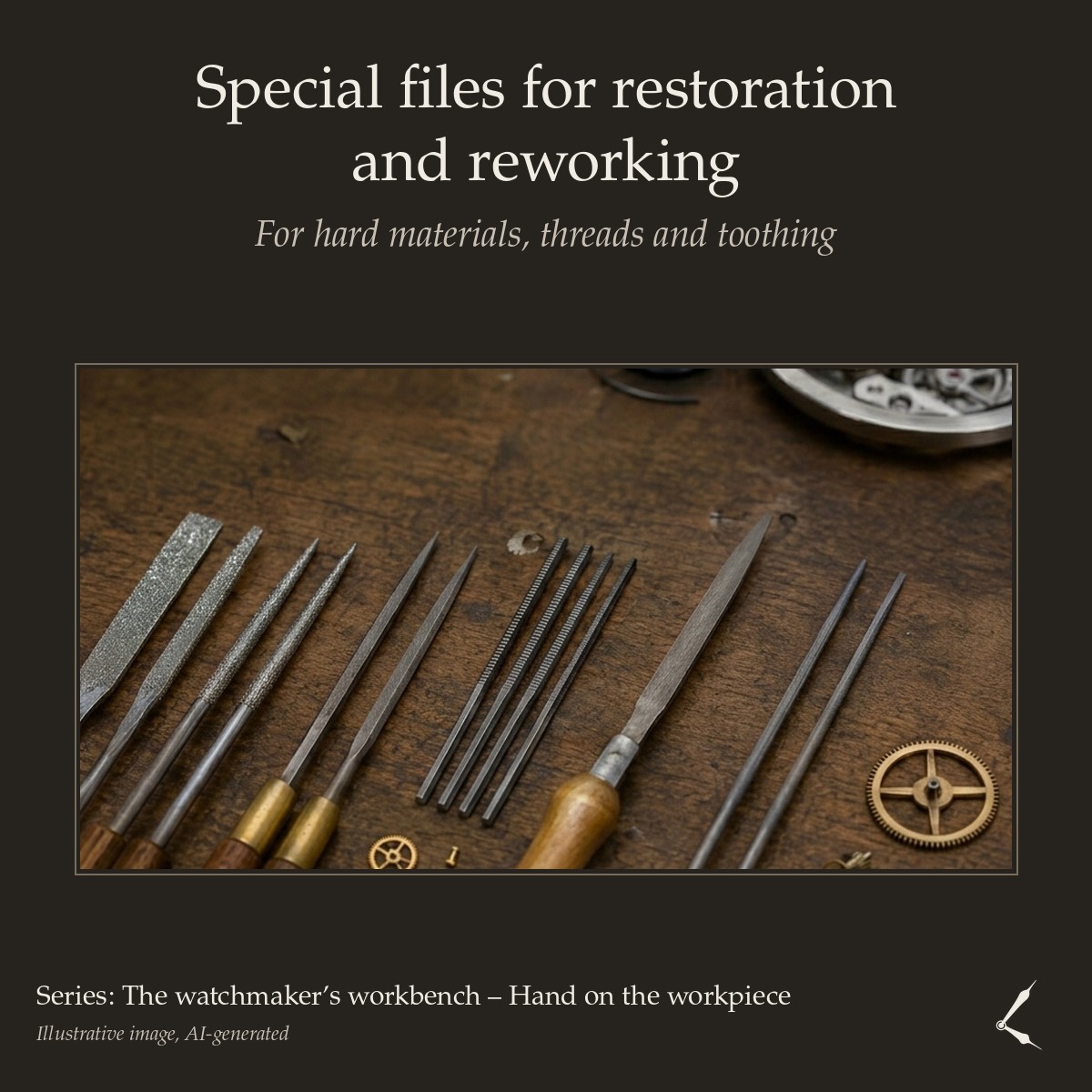
Special files are used wherever hard materials, damaged threads or fine toothing can no longer be worked cleanly with classic files. This group of tools is not designed for removing bulk material, but for targeted reworking and precise correction of shape.
Hard materials
Diamond files are the right choice for hard materials because they have no conventional cut but are coated with diamond particles. They are suitable for working hardened steel, whereas ordinary steel files wear out considerably faster on such materials.
Emery buffs are similar to diamond files but are designed to be even finer, and are therefore intended for fine work and finishing. They are suitable for soft and hard materials alike and can be used as an alternative to stone files.
This makes it clear: the choice of file depends not only on the shape, but above all on the hardness and the surface quality required.
Threads and screws
Thread files are used where damaged threads have to be reworked. Typical cases are individual turns of a thread that have been damaged, for example, by improper handling; for this purpose the thread file has several profiles that match different thread pitches.
The screw slotting file performs another special task: it is used to file the slot into special screws by hand. This is important because not every screw in horology is available as a standard screw, and some parts have to be made individually.
The lathe produces the thread and the screw head; the file then adds the decisive manual step at the slot. This shows how closely preparatory machine work and fine handwork belong together in watchmaking.
Toothing
For reworking toothing in horology, rounding-up escapement files in the H5 and H8 versions are used. The file is the same width along its whole length; the flat side carries the cut, while the round side remains smooth.
In repair practice it is used to rework individual damaged teeth of a wheel. Up to five individual teeth can be replaced; if the damage is greater, making a new wheel is more practical.
The inserted replacement tooth is then matched to the shape of the remaining teeth with the rounding-up file. This is not about coarse correction, but about restoring a tooth form that already exists.
Conclusion
Special files make sense wherever hard materials, threads or toothing can no longer be worked cleanly with classic tools. The focus is not on rapid removal, but on targeted adjustment and reworking.
Each of these files has a very particular field of use, and that is precisely where its value lies. This specialisation ensures that a damaged spot can become a working component again.
Featured image: illustrative image, created with AI.