This article was translated from German. Despite our care, some technical terms may be imprecise. The German version is authoritative.
Focus: The theory of time
Every mechanical timepiece, whether a monumental turret clock or a delicate wristwatch, begins with the same fundamental component: the motive power. It can be described as the heart or the “power store” of the movement. Its sole task is to supply the regulating organ – the pendulum or the balance – with the energy it needs to keep up its oscillations against friction and air resistance.
In the history of horology, two main types of motive power have prevailed, and they define a fundamental conflict of the craft: the struggle between ideal precision and practical mobility.
We are talking about weight drive and spring drive.
The weight: the epitome of constancy
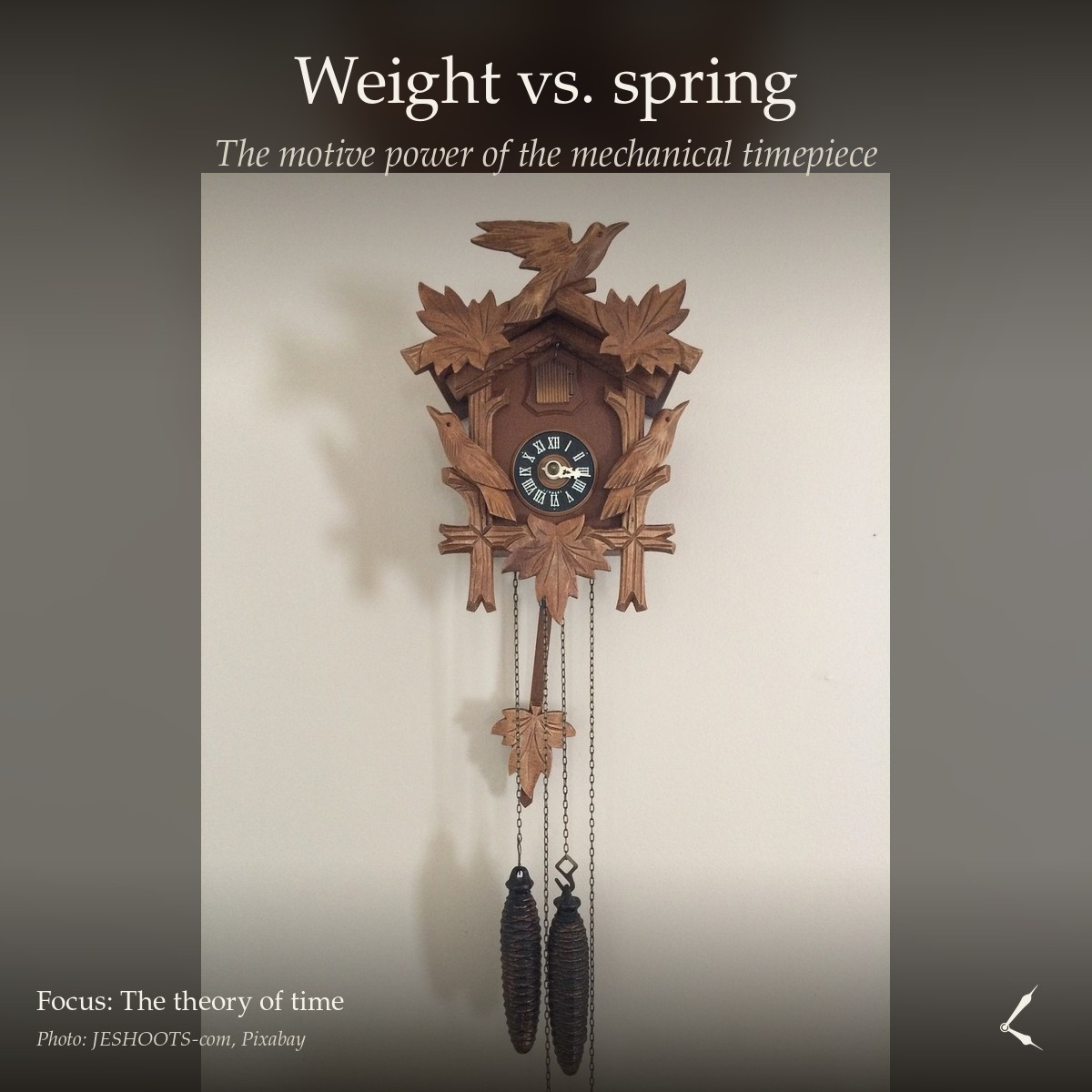
Weight drive is the oldest form of motive power in wheeled clocks. Its principle is pure, unadulterated gravity.
- The great advantage: A weight delivers an absolutely constant driving force. From the moment of winding until the end of the running period, the force that the weight exerts on the going train is identical. For a regulating organ whose precision depends on an even supply of energy, this is the ideal state.
- The decisive disadvantage: Weight drive works only in stationary clocks. Because the weight has to descend vertically, the clock is tied to a fixed place.
For this reason, weight drive is still the undisputed choice today for all high-quality precision pendulum clocks, where mobility plays no part but pure accuracy of rate is everything.
The spring: the revolution of portability
Spring drive was the technical revolution that made the timepiece mobile and freed us from dependence on stationary turret clocks and longcase clocks. The mainspring is documented as early as about 1430. Around 1500, watchmakers such as Peter Henlein used it to build timepieces that could be carried “in the bosom or in the purse”.
- The great advantage: Spring drive can be used in all timepieces, however they are oriented or moved. It is the most widespread form of motive power in horology.
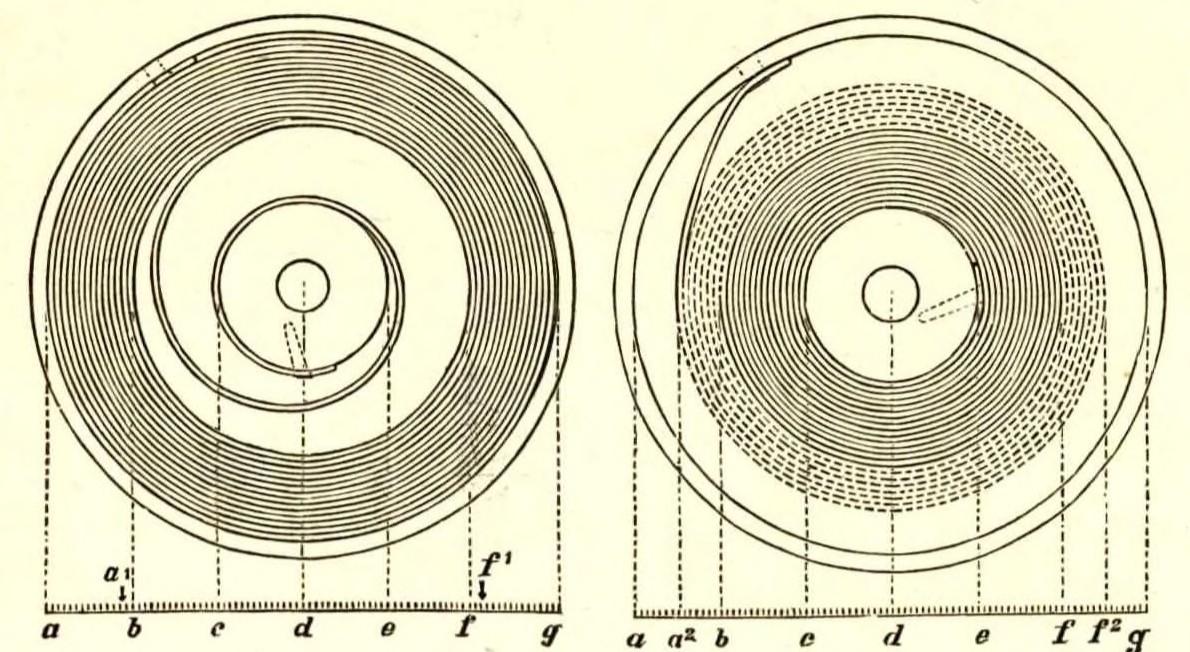
- The decisive disadvantage: The spring delivers an uneven force.
This disadvantage is the central problem of the portable timepiece. A fully wound spring delivers a much greater force than one that has almost run down. This variable transmission of force is the natural enemy of precision.
The solution: the struggle for even force
The uneven drive of the spring called the greatest minds of horology into action. How could an uneven source of power be made to deliver an even force?
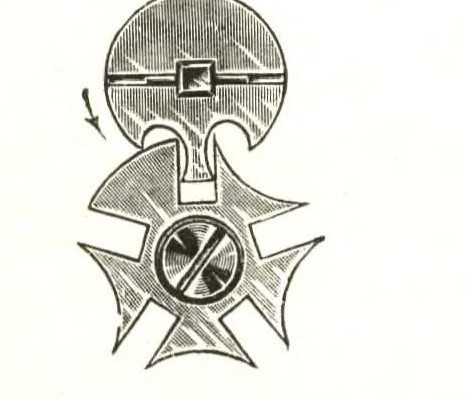
There were various approaches, such as the “recoiling ratchet and click” or the “stop work” (e.g. the Maltese cross), which above all simply switch off the strong force after full winding.
The most ingenious and technically most elegant solution, however, is the fusee (French fusée).
This design achieves complete equalisation of the force. The principle is pure, applied physics:
- The barrel (the power store) is not connected directly to the going train, but via a chain or a steel band.
- This chain is connected to the “fusee”, a cone-shaped arbor that drives the first wheel of the going train.
- The compensation:
- When the spring is fully wound (maximum force), the chain pulls at the smallest diameter of the fusee. The lever arm is short, and the torque is reduced.
- As the spring runs down and grows weaker, the chain unwinds from an ever larger diameter of the fusee. The lever arm becomes longer, and the torque is increased.
Thanks to this constantly adjusting lever arm, the decreasing force of the spring is perfectly balanced. The torque delivered to the going train remains – as with weight drive – almost perfectly constant.
Although the fusee has become rare in modern wristwatches (in favour of special spring alloys and escapement designs), it remains a monument to the genius of the old masters. They solved a fundamental physical problem and so paved the way for the portable precision timepiece.
Further reading: Steel, brass, silver steel: the watchmaker’s choice of materials
Quotation translated from the German by Ernst Westphal e.K.