
This article was translated from German. Despite our care, some technical terms may be imprecise. The German version is authoritative.
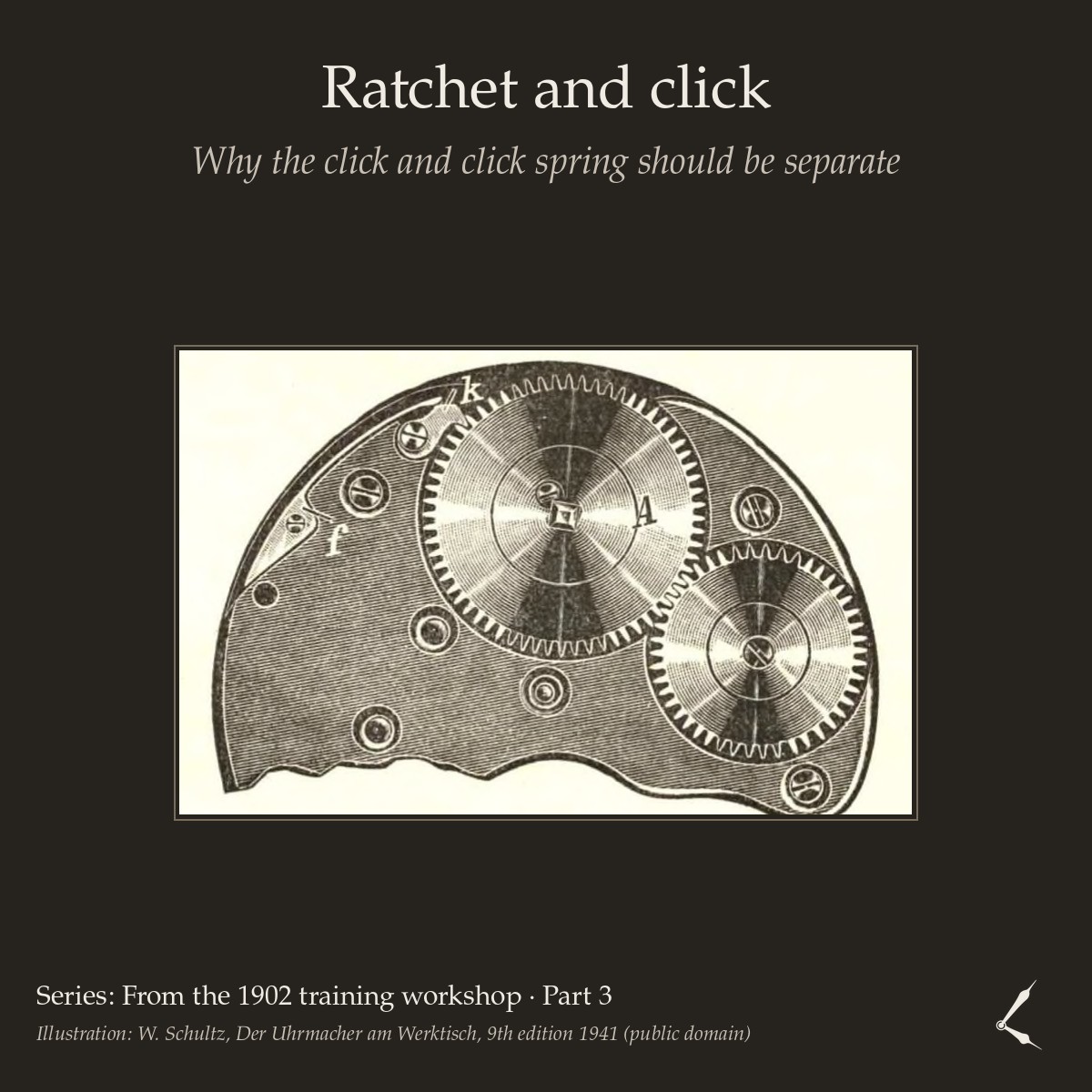
Anyone who winds a watch relies on a small component: the ratchet and click. It lets the ratchet wheel turn on during winding and holds the tensioned mainspring as soon as you let go of the crown. How much spring belongs in a barrel was the subject of the previous part. Today we look at the part that holds this power.
In “Der Uhrmacher am Werktisch”, Wilhelm Schultz counted the ratchet and click among the simplest and most easily understood parts of a pocket watch. For that very reason, he wrote, some repairers neglect it. As an example he cites newly fitted side click springs that engage the tooth spaces only by half or a third, but are three times as strong as necessary, presumably in the hope that they will then last longer.
A fault that cost a factory two years
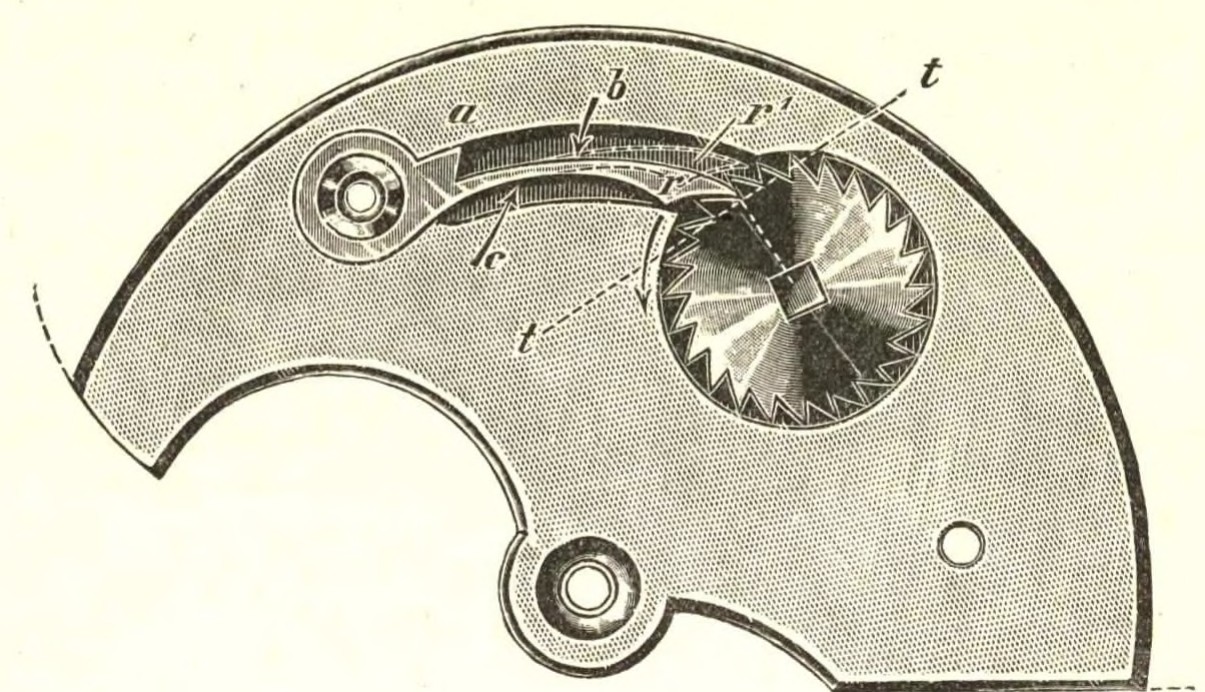
Schultz tells from his own experience how expensive a badly designed click can become. In the early 1880s the representative of a Swiss watch factory showed him a new lever calibre, cleanly made and with an excellent escapement. Only the ratchet and click stood out: click and click spring were made in one piece, a hook about 13 mm long that was springy over at most 5 mm of its length and almost 1 mm thick.
Schultz predicted to the representative that these springs would break by the dozen. The factory had his judgement checked by other experts and found it confirmed. But thousands of watches were already finished, and press tools and patterns worth many thousands of francs had been made for this form. It took about two years until the design was changed. Until then the factory supplied replacement springs free of charge, and every watchmaker had to temper them to pale blue before fitting them.
Why the one-piece design breaks
Schultz uses this design to show the basic problem. At rest, the ratchet wheel presses tangentially against the end of the spring. Because the point of support lies far outside this line, the pressure constantly bows the spring outwards. The designer then has only the choice between two evils:
- A thick spring is not elastic enough for the large movement during winding and breaks at the very first winding.
- A thin spring withstands the large movement, but is constantly bent at rest and after a while breaks at the bend.
From this follows his rule: making the click and click spring in one piece is always unfavourable. It is acceptable only if the head that serves as the click rests firmly and takes the whole pressure of the teeth itself. The springing part then only has to make the click snap in and can be as delicate as one likes. As a successful example Schultz names a ratchet and click by the Société horlogère Reconvilier. His conclusion nevertheless stands: the best is always a ratchet and click in which the click and click spring are separate.
The Glashütte ratchet and click: a model with an elongated hole
Schultz describes the ratchet and click of genuine Glashütte watches as a model in every respect. A winding wheel with 64 teeth also serves as the ratchet wheel, together with a strong click of characteristic shape and a click spring that rests on the click only with its very tip. Its special feature is an elongated hole in the click, which lets it slide lengthways on its boss. Schultz considers this hole essential, even though many experts regarded it as a source of faults. It has two tasks:
- Less lift for the spring. During winding the click slides forward, the tip of the spring glides into a recess in the click and is therefore lifted considerably less.
- No tension up to the very last point. After winding, the winding wheel always runs back a little, at least by the length of the hole. The mainspring is thus never wound fully up to the stop, and a stop work, if fitted, is relieved rather than put at risk.
Many factories copied the shape without understanding the principle. In their versions the click spring reached too far over the tip of the click, the recess had no effect, and the spring was lifted two to three times as high as in the original. Schultz shows a second fault on the back of the click: if it is bevelled the wrong way, the spring pushes the click backwards instead of forwards. It then occasionally stays on the tip of a tooth, and the wheel runs back. The remedy is the correct shape of the back. At every repair it must therefore be checked that the click slides back and forth reliably.
What matters in repair
For the simple ratchet and click with a side click spring, three checks are enough according to Schultz:
- The ratchet teeth and the click must be sharp.
- The click must engage fully, right down to the bottom of the teeth.
- It must not be able to slip upwards or downwards.
In addition, the spring should not be too strong, so that click and teeth wear little, and both the ratchet wheel and the click must be well hardened. If the wear suggests that the click is too soft, it is hardened again. For tempering Schultz gives exact colours: the foot and the springing part of the click spring light blue, the click only dark yellow to at most cherry brown, the ratchet wheel dark blue. This way the teeth wear little and still do not become brittle.
If the click or the ratchet teeth have to be reworked, this is done with fine files. For clocks, table clocks and antique clocks, ready-made click springs are available in the shop.
Conclusion
A ratchet and click is quickly made, but just as quickly made wrongly. Schultz’s lesson from the case of the 1880s still applies today: keep the click and click spring separate, ask the spring only to make the click snap in, and check depth of engagement, sharpness and hardness at every repair. The next part of the series deals with the stop work, whose stop wheel, the Maltese cross, prevents the mainspring from being wound up to its last coil.
Source: Wilhelm Schultz, Der Uhrmacher am Werktisch, 9th edition, revised by Fr. A. Kames, Berlin 1941, pp. 181–190 (§§ 397–418). All passages used appear in the 7th edition of 1924 and are by Schultz.