This article was translated from German. Despite our care, some technical terms may be imprecise. The German version is authoritative.
In the fine world of watchmaking, precision files are indispensable companions that rework delicate components with the greatest accuracy. While coarse workshop files provide rough material removal, needle files and escapement files open the way to masterly precision. Let us explore their characteristics, how to choose them wisely and their historical roots.
Differences: workshop files vs. precision files
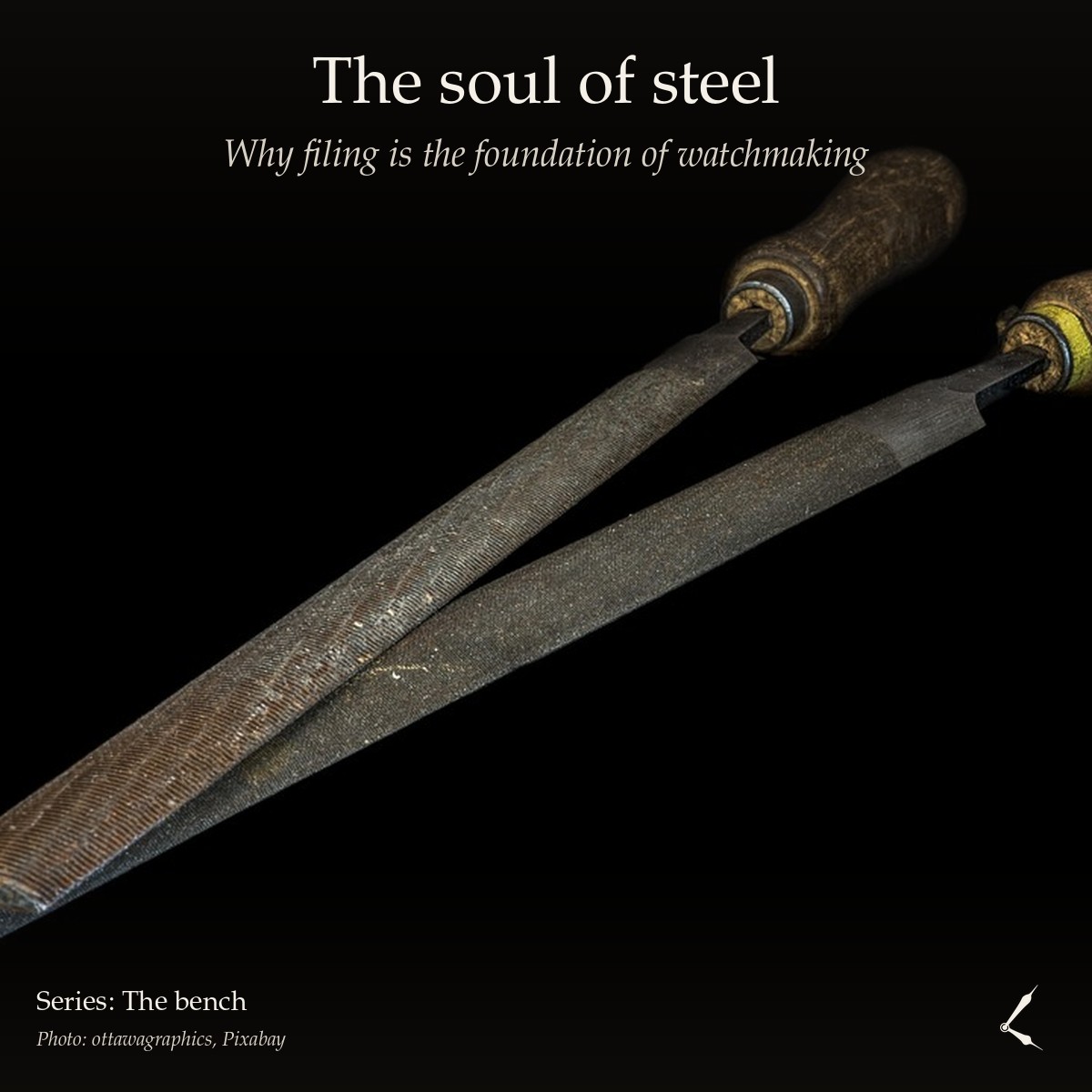
Workshop files, also called bench files, have their roots in the locksmith’s trade and are excellent for fast, coarse removal. They follow DIN standards with cuts 1 to 3 and are used mainly for roughing work. Precision files, by contrast, characterise the world of watchmaking, jewellery making and precision engineering.
These files do not follow uniform standards but manufacturer-specific ones that allow the finest nuances. Their cut ranges from H00 (very coarse) to H4 (very fine), more rarely even H8, for minimal filings and exact contours. Note: the German cut differs from the Swiss one, which is why an H3 file varies noticeably depending on its origin.
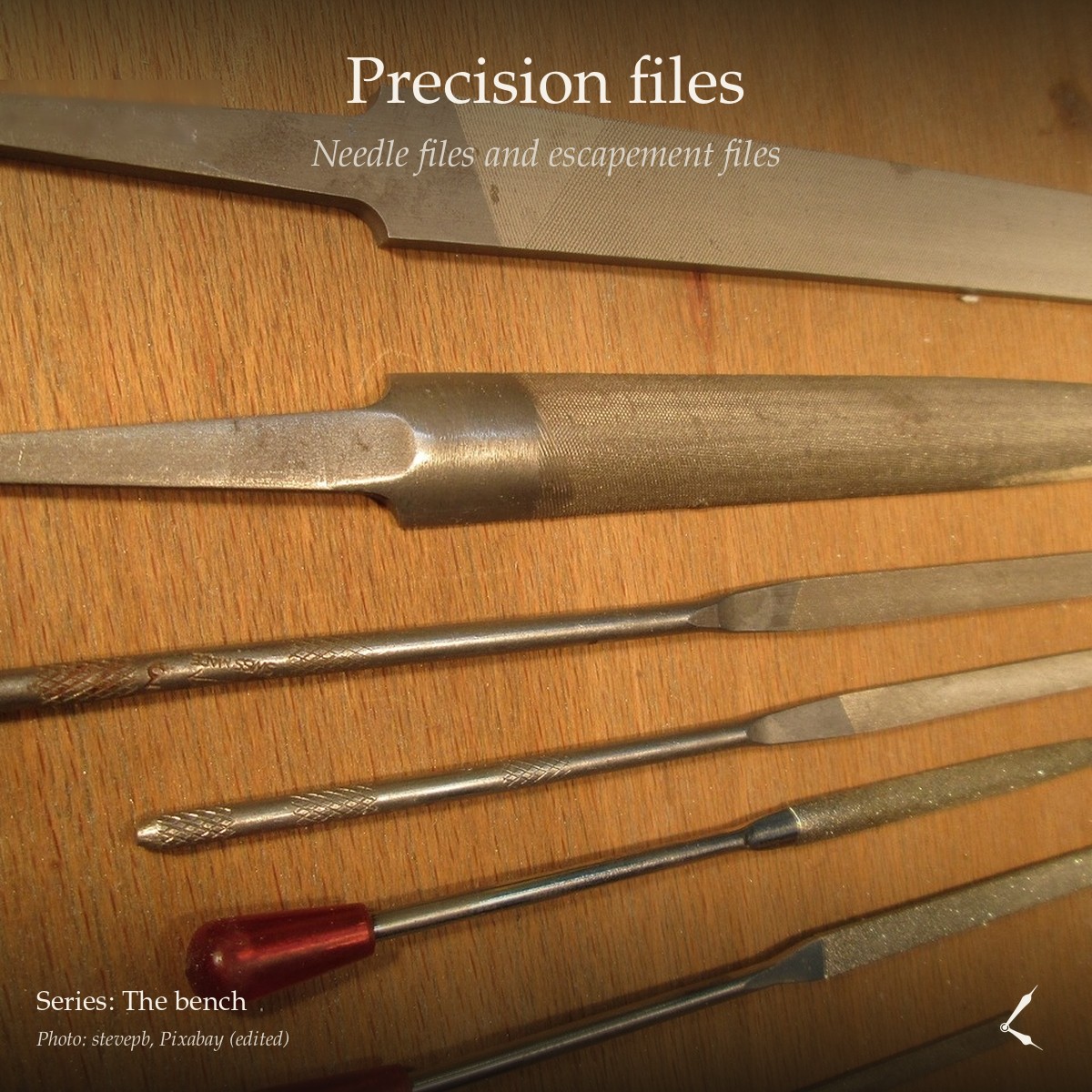
Needle files occupy the middle size class, with a round, blunt end for working without a handle, while escapement files are designed as the smallest specialists for fine work specific to watches.
Cut, cross-sections and point variants
The cut number indicates the fineness: H00 for coarse preliminary work, H4 for very fine filing. The number of cuts per centimetre also depends on the length of the file. Ordinary files are at about 60 HRC (Rockwell hardness), Vallorbe precision files at 66 HRC. Valtitan files reach 72 HRC at the surface.
The cross-sections include rectangular flat, triangular, square, round, half-round, crossing, barrette and knife. Blunt flat files smooth flat surfaces, pointed flat files reach into narrow recesses; crossing files shape curves, barrette files sharp corners.
The standard material, tool steel, predominates, supplemented by diamond coatings for extreme hardness. The range of sizes extends from massive bench files through medium-sized needle files to tiny escapement files.
Historical origin of escapement files
During industrialisation, factories supplied bare raw movements (ebauches), which watchmakers completed – often including escapement parts on the pallet fork. This is where escapement files (German Echappementfeilen) originated, named after the French “échappement”, meaning escapement.
“Correspondingly small files were needed for filing work on the pallet fork.” (Oliver Hambel, Grundfertigkeiten des Uhrmachers, 2nd edition 2021, p. 26)
These tiny tools made fine craftsmanship possible without machines and remain essential in restoration work, where accuracy in the range of hundredths of a millimetre counts.
Practical selection: material and workpiece
The right file is of little use if it does not match the material being worked and the shape of the workpiece exactly. Here, clear basic rules apply for the watchmaker:
The choice depends on the material: it is best to use separate files for brass and steel, or to mark the front and back by scribing. Brass filings clog the cut more quickly. Wilhelm Schultz already warned that anyone who works steel and brass indiscriminately with the same file will never have a sharp file at their disposal.
Choose to suit the workpiece:
- Blunt flat file for flat surfaces such as a 20 x 20 mm cube.
- Crossing file for curves.
- Barrette file for corners on wheel blanks.
- Triangular file for square holes in the ratchet wheel.
- Needle files for smaller components.
- Escapement files for filing work on the escapement.
Always match the size so that file and workpiece suit each other. In watchmaking, precision comes first.
Safety and handling of precision files
Every file is divided into the hardened blade with the cut and the tang. Because hardened steel is brittle and can break, the tang is soft-annealed. Files with a pointed tang must always have a firm handle that does not wobble – otherwise there is a risk of injury. This applies to bench files and sometimes also to needle and escapement files.
Needle files with a round end can be used without a handle. Always check the handle and grip!
Care through keeping brass and steel separate extends the life of these tools.
A craftsman’s conclusion
Precision files such as needle files and escapement files are the heart of the watchmaker’s mastery. They turn rough shapes into lasting precision and honour the traditional craft.
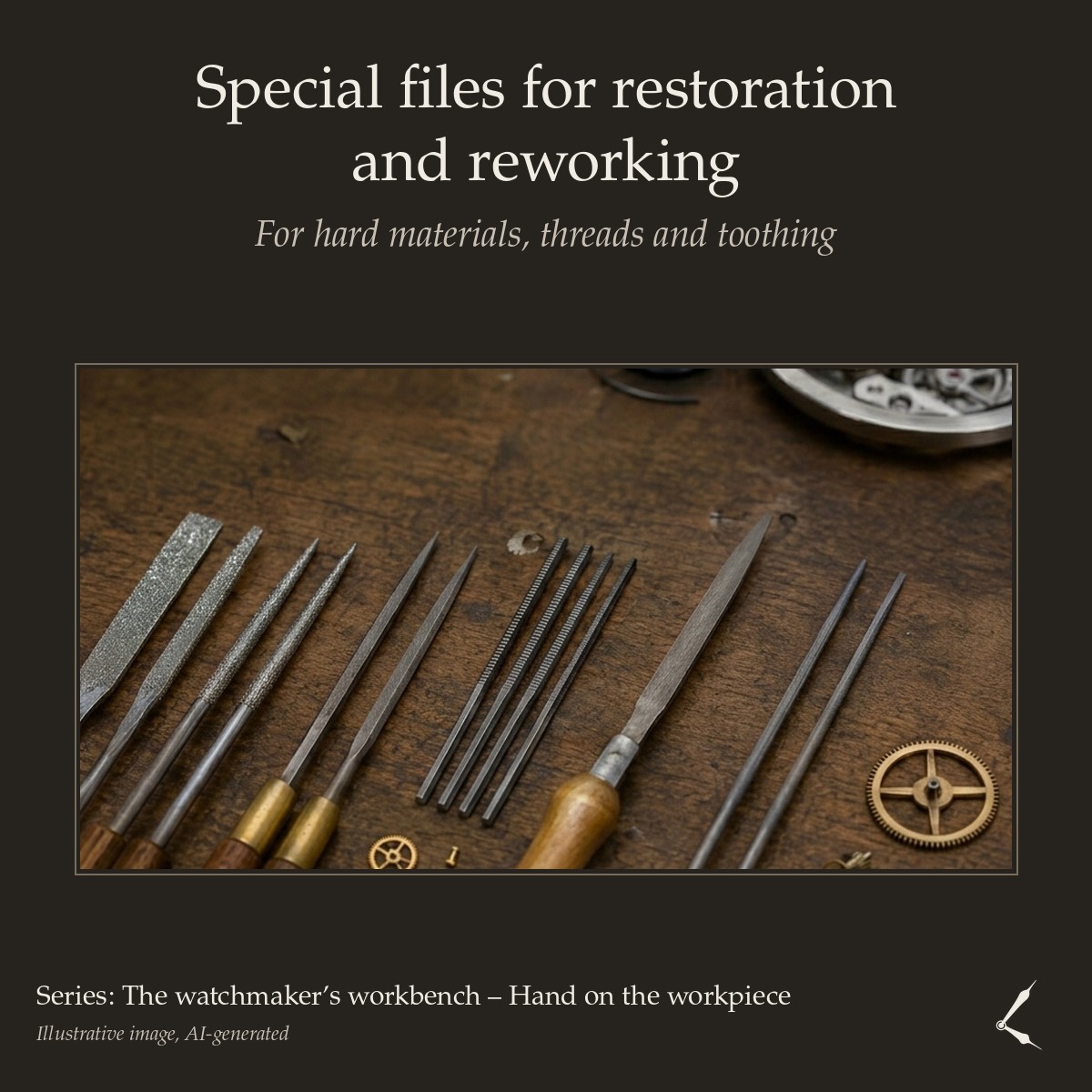
Outlook: In the next article we turn to special files for restoration: from diamond files to rounding-up files.
Quotation translated from the German by Ernst Westphal e.K.