This article was translated from German. Despite our care, some technical terms may be imprecise. The German version is authoritative.
Series: From the master’s workshop
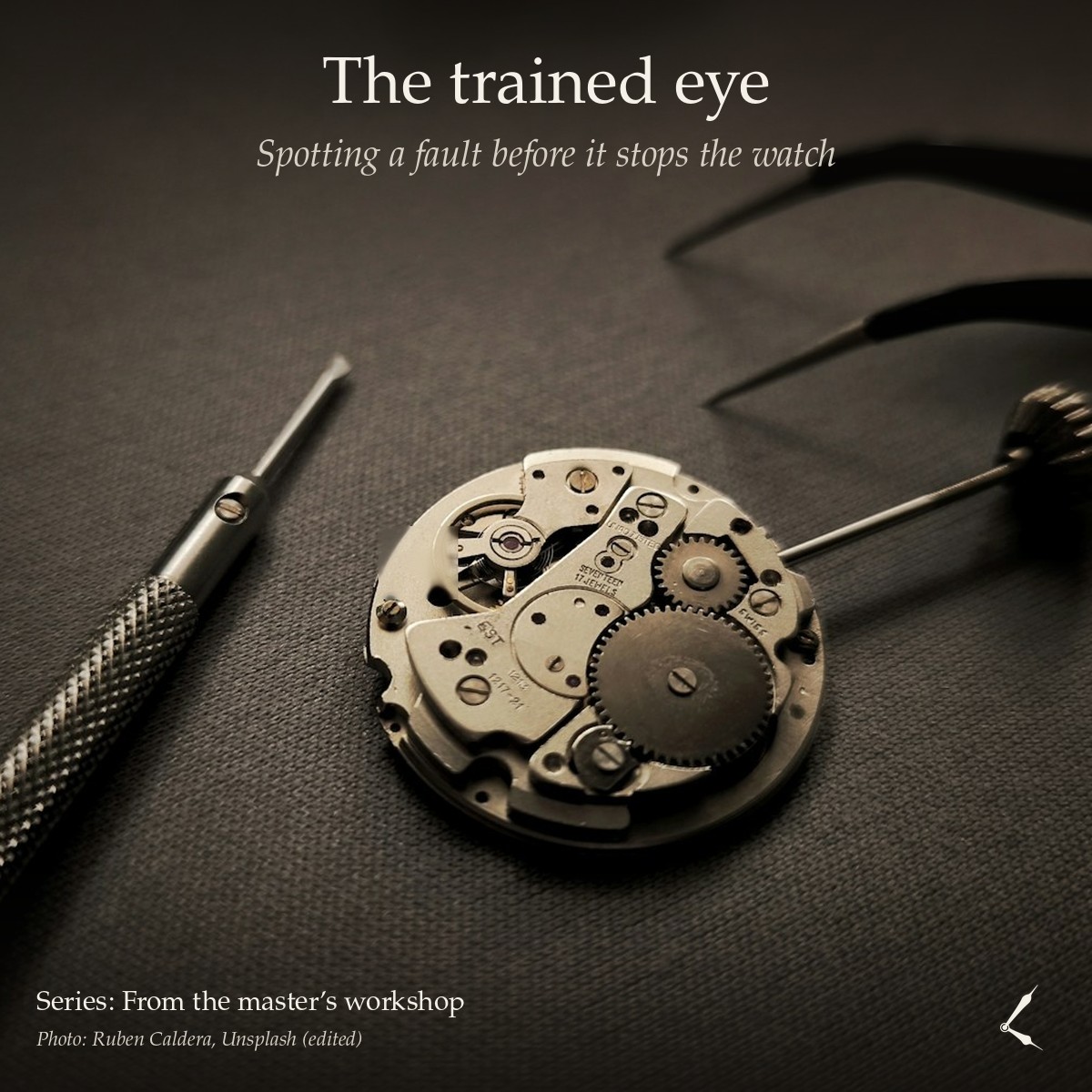
A watch stops. The layman says: “It must be overwound.” The parts swapper says: “The movement is old, we need a new one.” The true watchmaker, however, says nothing. He listens. He looks. He examines.
In the workshop literature there is hardly a sentence that sums up the watchmaker’s professional ethic as concisely as this one from Wilhelm Schultz‘s standard work Der Uhrmacher am Werktisch: “… the examination of the movement must already begin during dismantling.” So the repair does not begin with the screwdriver, but with the eye.
In this article we turn to the supreme discipline of our craft: fault diagnosis. After all, dismantling and cleaning a watch is craftsmanship – finding the fault before you undo the first screw is mastery.
The philosophy of examination: “Nothing is a small thing”
A common mistake that beginners (and unfortunately some professionals too) make is rushing in blindly. The watch comes onto the bench, and straight away it is uncased and dismantled. “The fault will show itself once everything is clean,” is the hope.
Schultz teaches us the opposite. Many faults disappear when the watch is dismantled – at least for the time being. A winding mechanism that binds, a balance spring that rubs or too little end shake can no longer be detected on the dismantled watch. Anyone who dismantles blindly destroys evidence.
The golden rule is therefore: repairing means examining first.
Listening: the pulse of the machine
Before we open the watch, we must listen to it. “Listening” is to the watchmaker what the stethoscope is to the doctor. A healthy watch has an even, strong beat. If it sounds dull in one position (e.g. “crown up”), that is a first clue to a pivot fault or a poise error in the balance. If, on the other hand, the beat “limps”, the watch is usually out of beat: the balance spring is not set correctly. We can hear both before the case is even open.
An irregular, jolting beat can point to the balance knocking – a sign of too much power. This knowledge guides our hands as soon as we open up the movement.
The classic among the “small things”: fouling of the hands
It is often the most trivial things that bring a watch to a standstill. Wilhelm Schultz pays particular attention to examining the hands, and with good reason. Fouling of the hands is insidious. If the minute hand touches the hour hand ever so lightly, or if the seconds hand rubs against the glass, this can reduce the amplitude of the balance so far that the watch stops hours later.
This fault is impossible to find once the watch has been dismantled. It must be diagnosed beforehand. A searching look from the side, turning the hands round the whole dial and checking the vertical clearance are obligatory. As Schultz warns: a watchmaker must never think himself too good to rule out even the simplest causes first.
Examination during dismantling
When we finally reach for our tools, our attitude does not change. We do not dismantle in order to throw parts into the cleaning machine. We dismantle in order to check.
- Is there too much shake in the barrel bearing? (Check before the bridge is removed!)
- Are the pivots worn or rough?
- Has the oil in the bearings merely gummed up, or is there none left at all, so that the bearing has run dry?
Every component we take out of the watch tells us part of its story. A good watchmaker reads this story before he “washes it away” in the cleaning bath.
Conclusion: the eye repairs too
Wilhelm Schultz’s teaching is as relevant today as it was 100 years ago. Modern timing machines and cleaning machines are valuable aids, but they do not replace systematic thinking. Getting a watch running again is easy. But finding the one hidden fault that would stop it again in three months’ time – that is the art we strive for.
On your next repair, take five minutes more before you put the screwdriver to work. Your watch will thank you for it.
Quotation from Wilhelm Schultz, Der Uhrmacher am Werktisch, translated from the German by Ernst Westphal e.K.