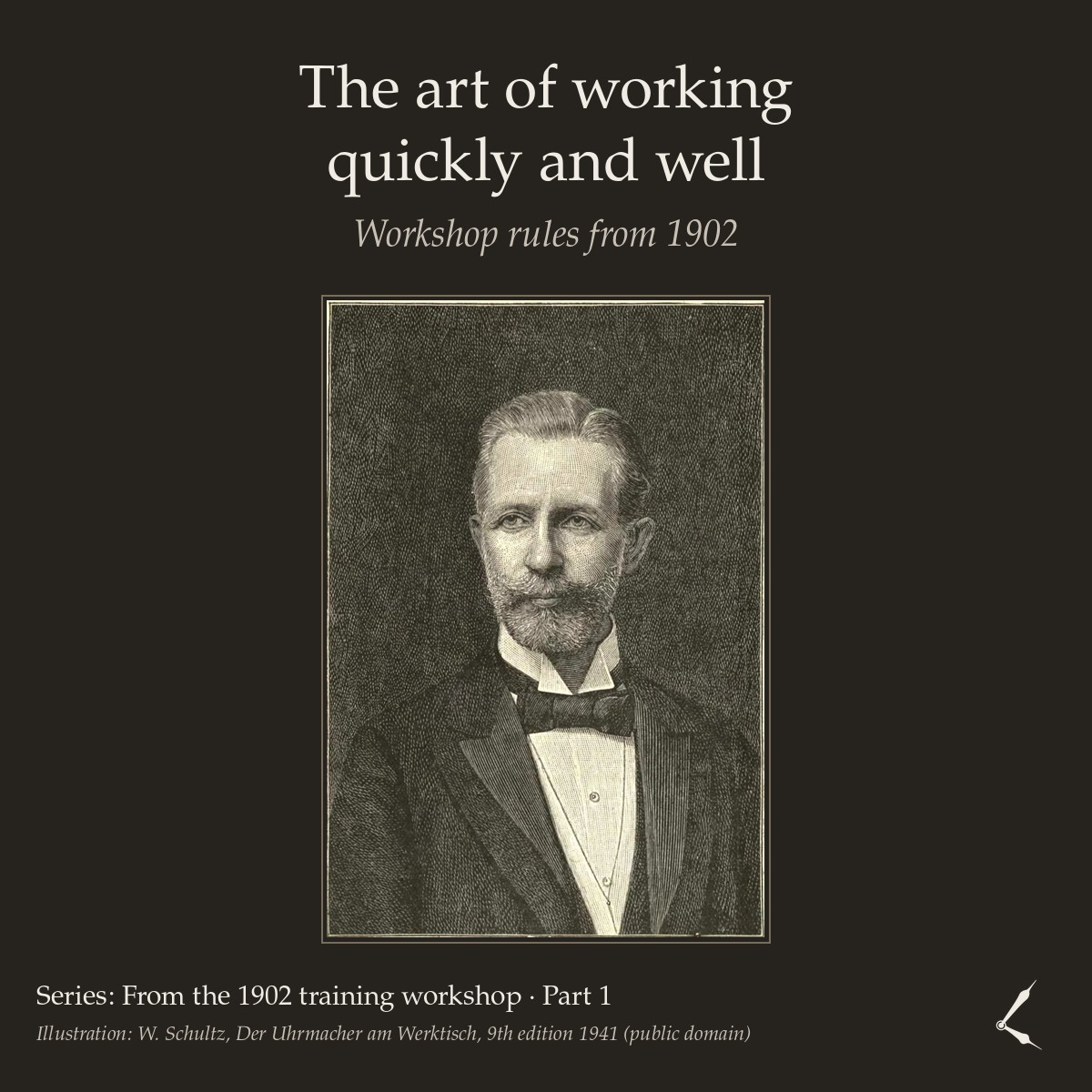
In August 1901 the Deutscher Uhrmacher-Bund, the German watchmakers’ association, commissioned the Berlin technical author Wilhelm Schultz (1854–1921) to write a book about everyday work at the bench. “Der Uhrmacher am Werktisch” (The Watchmaker at the Bench) appeared in April 1902. By 1941 it had run to nine editions, with translations into French, Spanish, Danish, Norwegian, Swedish and Dutch. Schultz did not write for those who make new watches but for the repairer, and expressly for the journeymen who were expected to carry out everyday work on pocket watches “cleanly and quickly”.
In this series we present selected chapters and carry them over to today’s bench. We begin with the chapter Schultz placed before all the others: the art of working quickly and well.
Good first, then fast: Schultz’s principle
How does one become a fast repairer? At first sight Schultz’s answer seems contradictory: by paying no attention at all to speed at the beginning. In his experience as a teacher, anyone who mainly wants to be finished quickly from the start will never become a good and fast repairer. Only the opposite route leads there.
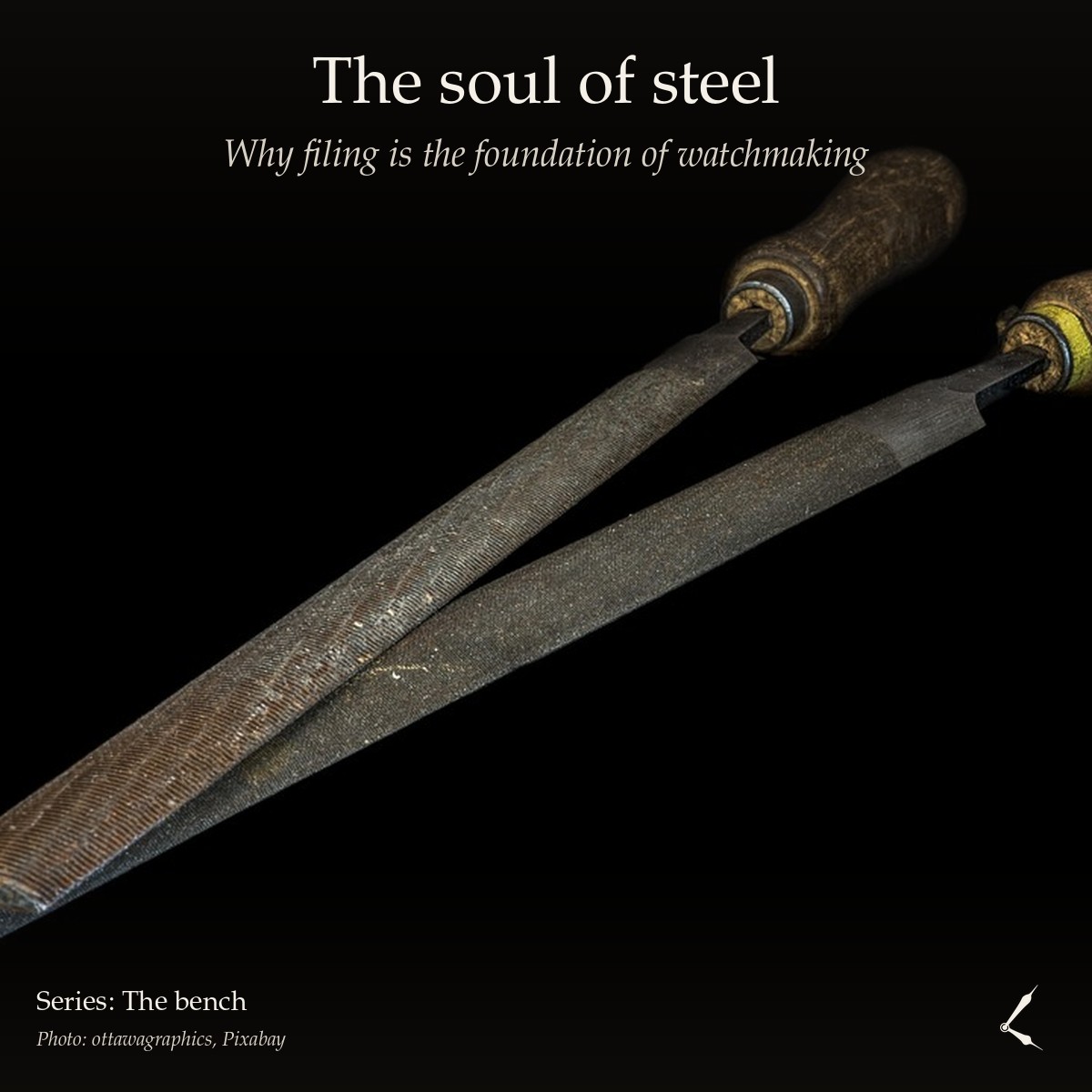
His example is the simple stroke of the file. For someone who knows how to file, a hundred flat, square strokes take not a second longer than a hundred crooked ones. Untidy work therefore saves no time. It only shows that someone never learnt to work cleanly. Whoever has trained himself to be careful over many years eventually cannot help filing flat. That “everything goes right” for a practised worker is therefore not luck for Schultz, but “skill honestly earned through years of self-discipline”.
An example: the filed points
Schultz shows how quickly carelessness becomes a habit with a simple apprentice’s job: a larger screw is to be turned from steel rod, so the workman files a point on each end of the rod. If the points are not exactly central, it is tempting to think that turning the rod down will remove the error anyway. For Schultz the workman makes two mistakes at once:
- He throws away the practice. Had he corrected the points carefully ten or twenty times, he could set them true at the first attempt for the rest of his life.
- He gets used to excuses. Anyone who thinks “It’ll work all the same!” here will soon stop being exact with shoulders and screw heads as well.
Nothing is saved: turning down a rod that does not run true costs more time and effort than turning down one that does.
With growing practice one then becomes faster of one’s own accord, at the same quality. Schultz cites the shaping of the inner coil of a balance spring: at first it takes ten or twelve attempts, later it succeeds after the third, the second or even the first bend. Until then, only perseverance helps.
Tools: enough of them, in good order, within reach
The second part of the chapter deals with tools. Schultz’s rule: if a job can be done equally well and equally quickly with simple tools, no special tool is needed. But every tool that genuinely makes a frequent job faster or safer belongs on the bench. He adds three points that can still be checked at any bench today:
- Separate files for steel and brass. Anyone who works both metals with the same file, says Schultz, never has a sharp file to hand.
- Screwdrivers in many sizes. Always use the largest screwdriver that fits; for screw heads that sit below the surface, however, the blade must be a little narrower than the head.
- The right tool for each job. Anyone who lifts off cocks and corrects balance springs with the same tweezers works neither well nor quickly. Fine work calls for tweezers of its own. And a graver that is not ground razor-sharp costs more time than the more frequent resharpening saves.
Order is just as important. Every tool needs a fixed place where it can be found without searching; for this Schultz recommends drawers with deep and shallow, large and small compartments. Only the few tools in constant use should stay on the bench itself. Everything else goes back into the drawer after each step. According to Schultz, the short pause this involves also does the mind good, because it guards against hasty work. In the evening the bench is cleared completely, and in the morning it is wiped clean.
Calm, not haste
Finally, Schultz disposes of a common misconception: a quick watchmaker does not move faster than others. Hasty work makes you nervous and cannot be kept up. The fast worker is marked by calm, considered movements and by experience: he sees at once whether a fault he has found matters for the running of the watch. This also means taking a movement apart as seldom as possible and looking for faults while dismantling it. We describe how to do this in our article The trained eye.
Conclusion: Schultz’s six rules
Schultz sums up the chapter himself in six rules, given here in today’s words:
- At the beginning, forgo speed until every job, even the smallest, turns out faultless.
- Then find small advantages in your working methods by thinking things through.
- Acquire every tool that helps you work quickly, and always keep it in the best condition.
- Give every tool a fixed place where it can be found with a single reach.
- Leave on the bench only the tools for the job in hand.
- Work calmly and deliberately, without haste but with constant thought.
More than 120 years later, much has changed at the bench, but little about these rules. The next part of the series deals with the component that drives every mechanical watch: the mainspring, why it breaks and how much spring belongs in a barrel. So far it is available in German only.
Source: Wilhelm Schultz, Der Uhrmacher am Werktisch. Hand- und Nachschlagebuch für den Taschen- und Armbanduhren-Reparateur, 9th edition, revised by Fr. A. Kames, Berlin 1941, pp. 12–26 (§§ 1–18). The passages quoted appear in the same words in the 7th edition of 1924 and are by Schultz. Quotations translated from the German by Ernst Westphal e.K.