
This article was translated from German. Despite our care, some technical terms may be imprecise. The German version is authoritative.
The mainspring is the energy store of every mechanical pocket watch and wristwatch. Why it is the better solution than a weight in the first place, we showed in Weight vs. spring. This article goes to the bench: how much spring belongs in a barrel, and what makes a new spring break again after only a few days?
Wilhelm Schultz devoted a chapter of its own to the mainspring in “Der Uhrmacher am Werktisch”. His starting point: because of the gearing of the going train and unavoidable friction alone, only part of the spring’s force reaches the escapement. The repairer must therefore remove everything that additionally binds or rubs, and every fault that can make the spring break.
Fault no. 1: the spring that is too strong
Schultz saw the most common fault in a well-meant reflex: fitting the strongest possible spring and filling the barrel with it. In his experience, a cylinder or lever watch in good order needs only a moderately strong spring to run briskly and regulate well.
A spring that is too thick has no room in the barrel to develop. The balance then swings widely only shortly after winding; after that the amplitude falls off, and the rate changes noticeably. Schultz describes the customer who always winds his watch before going to bed, but goes to bed sometimes at eleven, sometimes at two and sometimes at five in the morning: for him the watch runs differently every day. On top of that comes the risk of breakage, for according to Schultz a spring that is too thick, in a barrel that is too full and wound round an arbor that is too small, will soon break.
How much spring belongs in the barrel?
For the right proportion Schultz gave two figures from his own practice:
- When let down, the barrel holds 13, at most 13½ coils.
- As the spring runs down, the barrel makes 6 full turns.
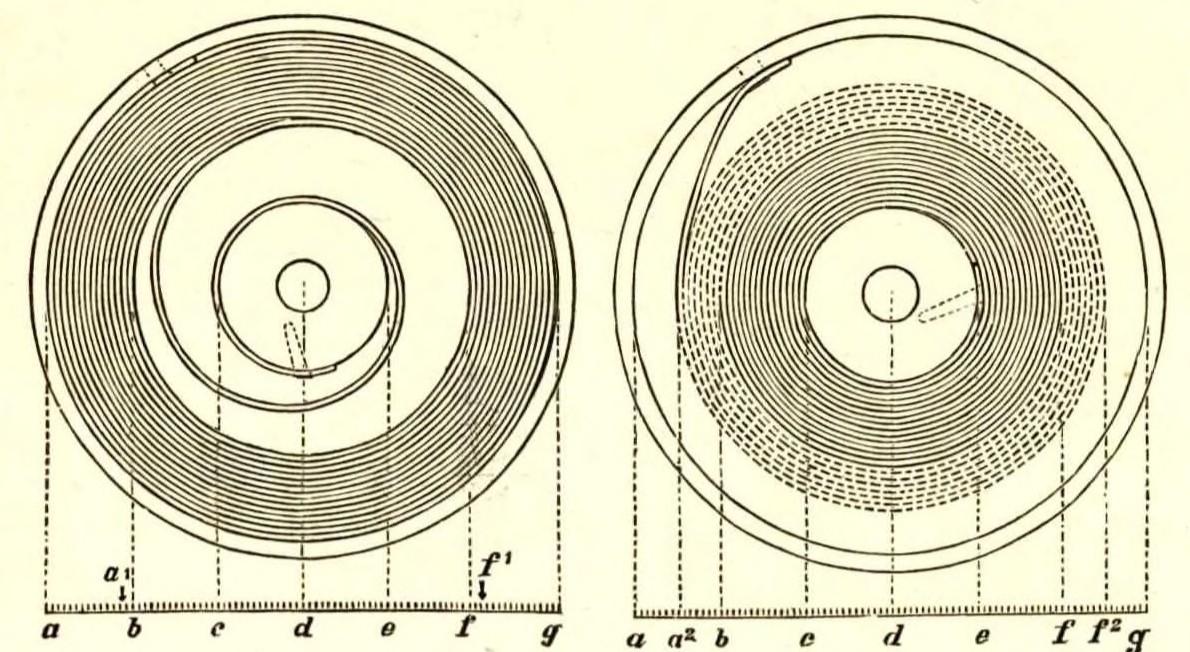
This assumes that the barrel arbor measures one third of the inner diameter of the barrel, “as is generally prescribed”. If the arbor is larger, too few turns result; Schultz then turned it smaller and at the same time filed it to a snail shape, so that the spring winds up evenly. If the arbor is too small, he placed a narrow strip of well-oiled card between the arbor and the inner coil. For wound round an arbor that is too small, the spring breaks easily.
With a model calculation Schultz showed why the older textbook rule does not work out. It assumed 14 coils which, let down, take up one sixth of the barrel diameter on each side. His example works with round numbers, a barrel of 84 mm and a spring strip 1 mm thick. Result: fully wound, 21 coils lie round the arbor, and only 7 mm remain for the spring to unwind. His conclusion: better to shorten it. Instead of 13 there should be only 12 coils, which when let down fill one seventh of the diameter. Behind this are two rules that Schultz places at the end:
- The barrel turns as many times as the spring, fully wound, has more coils than when let down.
- The greatest number of turns is obtained when the let-down spring covers as much of the barrel as remains empty.
For choosing a new spring it followed that it should already fit into the barrel while still in its wire ring. Usually Schultz then had to break off a further piece to get the barrel empty enough. As for the width of the strip, that is the height of the spring: nothing may bind. A narrower spring that develops freely gives more force than a wider one that rubs. Schultz rejected turning barrel covers thin to make room for a wider spring, because thin covers are easily pressed in.
Today the right mainspring is chosen by height, strength and length, usually from the data for the calibre. Schultz’s rule of thumb remains a good cross-check when a watch does not run evenly despite a new spring.
Taking out, winding in, punching
According to Schultz, many broken springs arise during the repair itself:
- Taking out: Do not tear out the inner end and do not let the spring jump out freely, but let it out carefully into the left hand, closed tightly round the barrel.
- Winding in: In the mainspring winder use an arbor of suitable diameter. If it is clearly smaller than the barrel arbor, this single winding alone can cause the later breakage.
- Cleaning: When wiping the spring with a cloth or tissue paper after cleaning it in benzine, do not pull it apart.
- Punching: Make the inner hole exactly central and a little longer than the hook on the barrel arbor. Anneal the outer end only over about 8 to 10 mm and grind it bright with the emery buff. A small rounding at the end prevents the spring from knocking off the head of the barrel hook when it is fully wound.
Shortening and re-punching? Outside yes, inside no
May a broken spring be shortened and given a new hole (“nachsetzen”)? Schultz made a strict distinction. If half a coil or a whole coil breaks off at the outer end, the freshly punched spring may even work better than before, because many springs were too long anyway. At the inner end, on the other hand, even a short missing piece disturbs the even spiral form. On winding, a sudden increase in tension arises near the arbor, and the spring soon breaks again. His verdict: considering how little a new spring costs, re-punching at the inner end should be “frowned upon once and for all”. As a makeshift he allowed it only for the watchmaker in the provinces who has no material house in his town, and even then only with an honest explanation to the customer.
For Schultz, honesty was the heart of the matter in any case. In his own business, when a spring had broken, the customer was seated on a chair beside the bench, the barrel was opened before his eyes and he was given the broken spring to take away in a small paper envelope, as proof that a new one really was being fitted. Eight or nine out of ten customers declined, but they had seen the good will.
Conclusion
A mainspring rarely breaks just like that. Too strong, too long, wound round an arbor that is too small or mistreated when it was taken out: most of the causes that Schultz described more than a hundred years ago can be avoided at the bench. In the next part of the series we stay with the barrel and look at the ratchet and click: the ratchet wheel and the click that hold the wound-up power. So far that part is available in German only.
Source: Wilhelm Schultz, Der Uhrmacher am Werktisch, 9th edition, revised by Fr. A. Kames, Berlin 1941, pp. 240–253 (§§ 554–598). All passages used appear in the 7th edition of 1924 and are by Schultz. Quotations translated from the German by Ernst Westphal e.K.