This article was translated from German. Despite our care, some technical terms may be imprecise. The German version is authoritative.
Focus topic: The bench
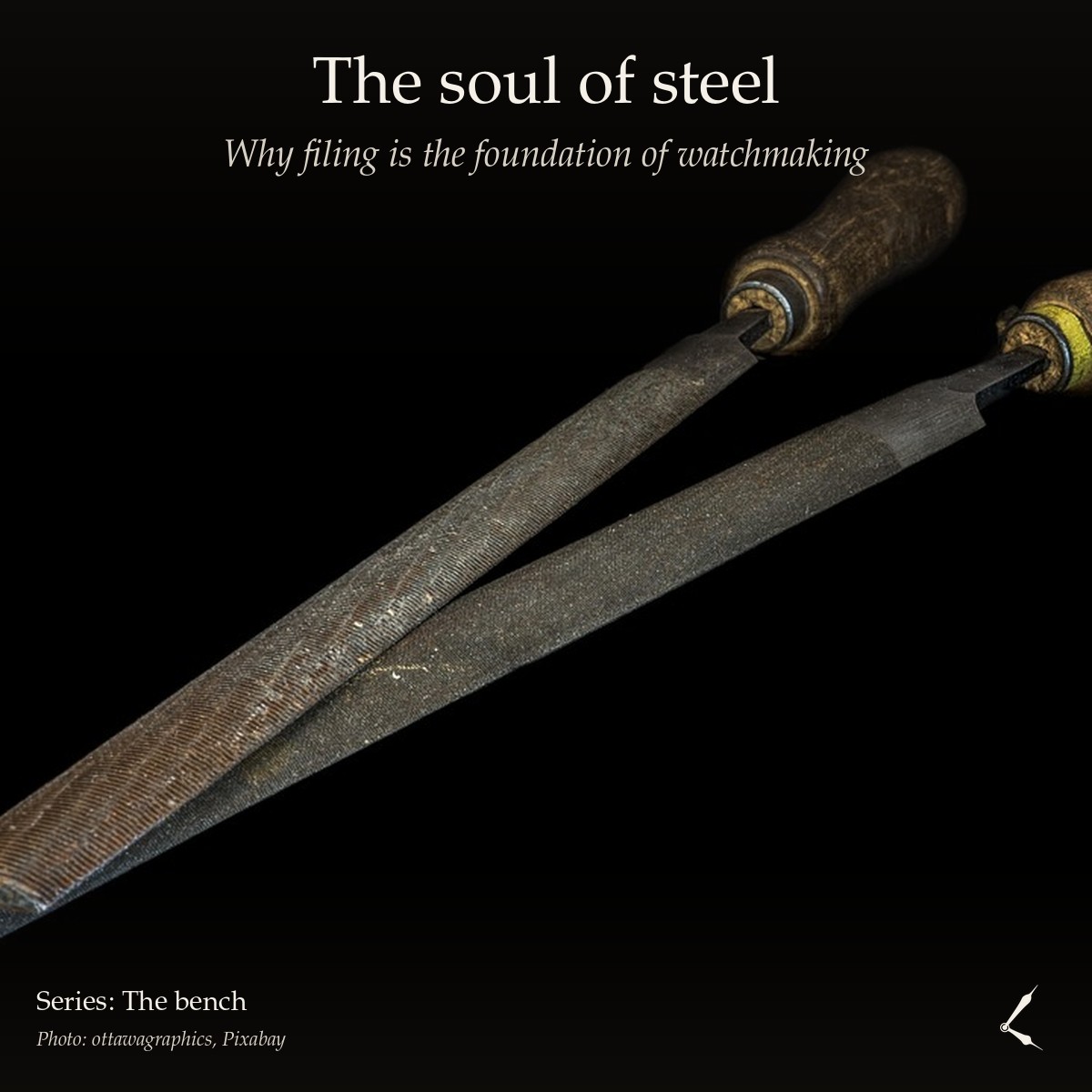
Before we talk about tourbillons, escapements or minute repeaters, we have to talk about the foundation. About a skill that is often smiled at, misunderstood in watchmaking schools as a mindless exercise, and yet perhaps the most important basic skill of all: filing.
Many who enter our craft want to go straight to the lathe or assemble complex movements. Filing a simple steel cube seems trivial. But that is a fundamental mistake.
Wilhelm Schultz, one of the great masters, wrote in essence that a watchmaker who cannot file flat saves no time either – he only proves that he never learnt how. Filing is not mere stock removal (so-called “roughing”); it is a metal-cutting manufacturing process and the purest form of precision work by hand.
Here, at the bench, the watchmaker learns what precision in the range of hundredths means – with nothing but his hands, his eye and a piece of steel.
More than abrasion: the principle of the file
A file is far more than a rough piece of metal. It is a high-precision cutting tool. Every single tooth on a file blade is a tiny wedge that lifts a chip from the material.
How this wedge works is defined by three angles:
- The clearance angle (α): It ensures that the cutting edge can enter the material at all.
- The wedge angle (β): It determines the stability of the cutting edge. A more acute wedge cuts more easily, a more obtuse one is more stable.
- The rake angle (γ): It decides whether the file cuts (positive angle) or scrapes (negative angle).
Understanding this geometry is the first step from “craftsman” to “technician”.
The master’s tool: choosing the right file
For our purposes we do not distinguish between the dozens of shapes, but between two main categories:
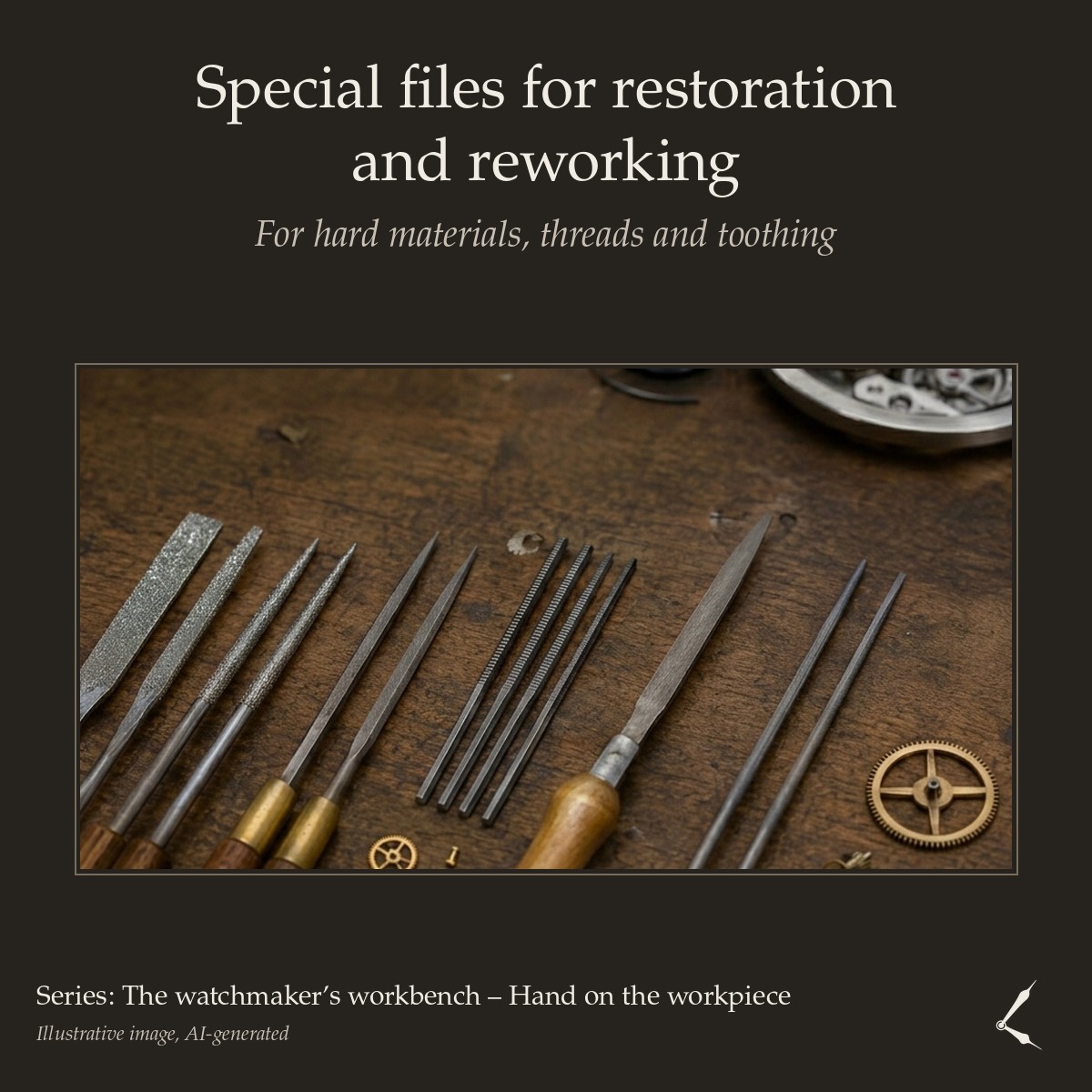
- Workshop files (also bench files): These are intended for coarse material removal. They can be recognised by their cut according to DIN (e.g. cut 1, 2 or 3).
- Precision files: This is our field. They are used for fine work and finishing. Their cut is usually given as a number, often according to the Swiss designation, from H00 (very coarse) to H4 (very fine) or finer still.
Important: the cut number is a fineness class. How many cuts there are per centimetre also depends on the length of the file: with the same number, shorter files have more cuts per centimetre. A common mistake is to assume that a “Swiss cut 3” is identical to a “German cut 3”. They are not. For today’s exercise we concentrate on a high-quality blunt flat precision file.
The technique: the way to the perfect surface
This is where the wheat is separated from the chaff. Filing a perfectly flat surface requires discipline, rhythm and absolute control of the body.
The stance: The file is guided with both hands. The right hand grips the handle, while the thumb, index finger and middle finger of the left hand guide the tip. Many watchmakers prefer to file sitting down, as this allows a steadier posture. What matters: the file and the forearm should form a line.
The movement: This is the secret. Anyone who “scrubs” hastily back and forth will never produce a flat surface. He inevitably produces a convex, “crowned” surface.
The correct movement is steady, even and straight.
- The file cuts ONLY on the forward stroke. Only here is light pressure applied.
- Use the full length of the file blade, not just a short section in the middle.
- At the end of the stroke the file is lifted vertically off the workpiece.
- Without pressure, the file is set back at the start.
- Repeat.
If you draw the file back across the workpiece, you not only damage the cutting edges of your expensive file, you also ruin your surface.
The check: measuring what you have made
Have you produced a flat surface? The eye alone deceives.
- Deburring: First remove the fine burr (the upset material) at the edges. A burr falsifies every measurement.
- The knife-edge square: The tool of choice is a knife-edge square (a precise 90° reference square).
- The light-gap test: Hold the workpiece and the knife-edge square firmly together and look towards a light source. The light now shining through mercilessly reveals every unevenness. If you see light, keep filing.
Respect for the tool
Finally: a file is only as good as the care it receives. The chips produced in filing clog the cut. A clogged file not only cuts badly, it also causes deep scores in the workpiece.
Clean your files regularly with a stiff natural-bristle brush. Stubborn chips (especially brass, which clogs files more quickly than steel) are carefully removed with a piece of brass sheet filed to a point.
Filing is meditation. It is the direct connection between the watchmaker’s vision and the raw material. It teaches us patience and an unconditional respect for precision – virtues without which no movement can ever be brought to life.
Read more: Weight vs. spring: the heart of the movement and the eternal struggle for even force