This article was translated from German. Despite our care, some technical terms may be imprecise. The German version is authoritative.
The previous article looked at how the escapement controls the running of the movement. Before its function is checked, however, it is worth taking a close look at the going train. Its wheels and pinions are meant to pass the driving force on to the escapement as evenly as possible and with little loss. If even one of these depthings is faulty, a loss of power in the going train can wrongly be attributed to the escapement.
This article therefore deals exclusively with the depthings between wheel and pinion. The engagement between escape wheel and pallet fork follows in the next part of the series.
What a good depthing has to achieve
A good depthing cannot be recognised merely by the fact that the going train turns. What matters is how evenly the driving contact passes from one wheel tooth to the next.
For the test, the pinion concerned is braked firmly enough that the depthing can clearly be “felt through” – but not so hard that the lower jewel cracks. Then the wheel is turned on very slowly, tooth by tooth. To tell the fault patterns apart precisely, Schultz recommends a movement of about one to two teeth per second. The transition should feel completely smooth: without butting, dropping, jarring or noticeable bumping.
If the wheel is moved through the depthing too quickly, several teeth can pass within a brief moment. Small irregularities then easily remain hidden. Only feeling the depthing through slowly reveals whether the teeth mesh continuously or whether the transmission of power is regularly interrupted or impeded.
The pressure on the pinion must be sufficient for the depthing to be genuinely felt. Excessive pressure must be avoided, however, because the lower jewel can be damaged, particularly with small pinions. The test therefore demands not only attention but also a carefully judged amount of force.
Schultz distinguishes five basic groups of faults that must be taken into account in the examination:
- The depthing is too deep.
- The depthing is too shallow.
- The wheel teeth have no clearance, or only insufficient clearance, in the spaces between the pinion leaves.
- The pinion is too large or too small in relation to the wheel.
- The tooth form of the wheel or pinion is faulty.
In addition, there may be problems with pivots and bearings. Resistance when turning therefore does not yet prove that the depth of engagement is wrong. A bent or tight pivot, a wheel that does not run true, individual teeth that deviate or an unsuitable tooth form can also impair the running.
Backlash is not depth of engagement
Backlash and depth of engagement must be judged separately. The two characteristics are related, but they do not describe the same finding.
Backlash here means the free space between a wheel tooth and the space between the pinion leaves. This free space must be present in every position of the wheel and pinion. If it is missing completely or in places, the teeth can jam.
The amount of backlash, however, does not reliably show whether wheel and pinion mesh too deeply or too shallowly. A depthing can have plenty of backlash and still be too deep. Conversely, a depthing that is too shallow can occur with comparatively little backlash.
Likewise, a depthing can feel even and smooth although the backlash is insufficient. This does not automatically mean that wheel and pinion mesh too deeply. Correcting the depth of engagement would then not necessarily remove the cause and could even spoil the previously smooth running.
Too little backlash becomes particularly critical when dirt gets into the depthing. Even small particles of dirt can fill a space between the leaves to the point where the running stalls. Schultz singles out the last depthing of the going train in particular: at the second wheel the remaining driving force is smaller, which is why an additional obstruction can have a particularly marked effect there.
For the check, the pinion is held still and the wheel is moved carefully against the pinion. Then, at no fewer than six to eight points, it is checked whether the wheel can be moved slightly back and forth. Examining several points is important because the backlash need not be the same all the way round.
In this way, places where the wheel does not run true can also come to light. In addition, the wheel teeth should be examined under the eyeglass so that individual teeth that are too thick, too short or otherwise irregular are not overlooked. A fault that occurs locally must not be hastily interpreted as a generally wrong depth of engagement.
Telling drop from butting
When the depthing is felt through slowly, a faulty depthing often makes itself known by a recurring jerk. For the further assessment, it is crucial whether this jerk is caused by drop or by butting, also called binding.
With drop, the departing wheel tooth loses contact with the pinion leaf before the following wheel tooth takes over the lead. A short free path arises in between. For a moment the wheel moves on without transmitting force to the pinion.
When testing slowly, this free path can be felt as a small drop. A comparatively smooth section then follows before the process repeats at the next tooth. As a result, the depthing does not feel guided throughout, but rhythmically interrupted.
With butting, this free path is absent. The following wheel tooth meets the next pinion leaf too early and has to overcome a noticeable resistance. When turning further, it feels as if the wheel tooth had to work its way over a bump. After a somewhat easier section, a distinct resistance occurs again at the next tooth.
Both faults impair the transmission of power in different ways. With drop, no force is passed on to the pinion during the free path. With butting, part of the driving force is needed to overcome the resistance between the teeth. A depthing that binds heavily can considerably weaken the flow of power to the escapement and, at worst, interrupt it altogether.
Fast running can conceal these differences. Anyone who moves several teeth through the depthing in one jerk may perceive only a general bumpiness. Only the slow test, tooth by tooth, makes it possible to distinguish the brief interruption of drop from the rising resistance of butting.
From symptom to cause
Drop and butting are at first observations made by feel, but not yet complete diagnoses. Different geometrical causes can lie behind the same symptom.
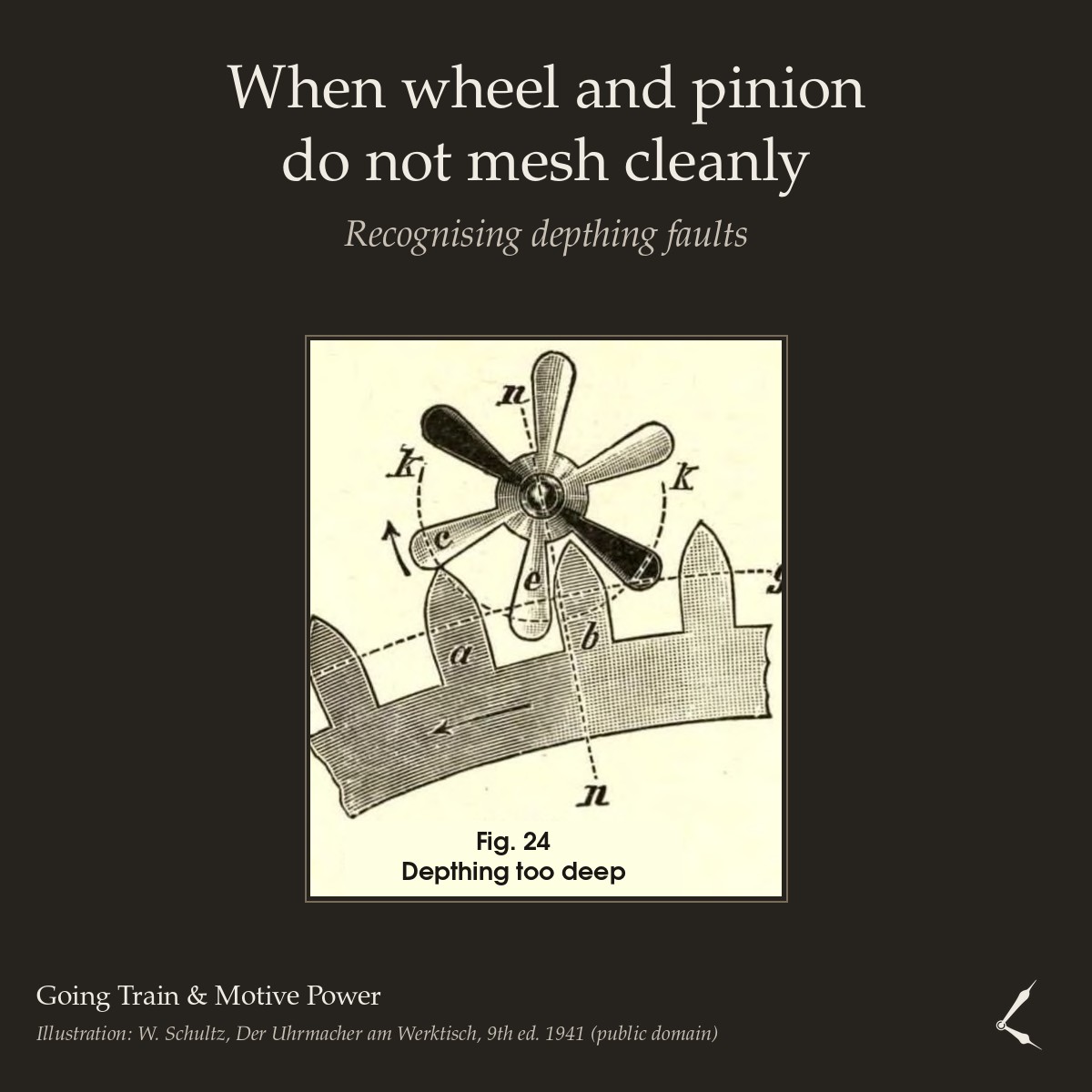
If drop occurs, there are two main possible causes: the depthing may be too deep, or the pinion may be too small in relation to the wheel. With a depthing that is too deep, the distance between the two arbors, or rather the position of the pitch circles, is not right. With a pinion that is too small, on the other hand, the depth of engagement may in principle be correct while the diameter of the pinion does not suit the wheel.
Butting, too, can have two different causes. Either the depthing is too shallow, or the pinion is too large in relation to the wheel. With a depthing that is too shallow, wheel and pinion are too far apart. With a pinion that is too large, on the other hand, the centre distance may be correct while the following wheel tooth still meets the next pinion leaf too early.
This gives the following basic classification:
- Drop: possibly a depthing that is too deep, or possibly a pinion that is too small.
- Butting or binding: possibly a depthing that is too shallow, or possibly a pinion that is too large.
- Insufficient backlash: a finding in its own right, not automatically a depthing that is too deep.
- Irregular running: also check the tooth form, whether the wheel runs true, the pivots and the bearings.
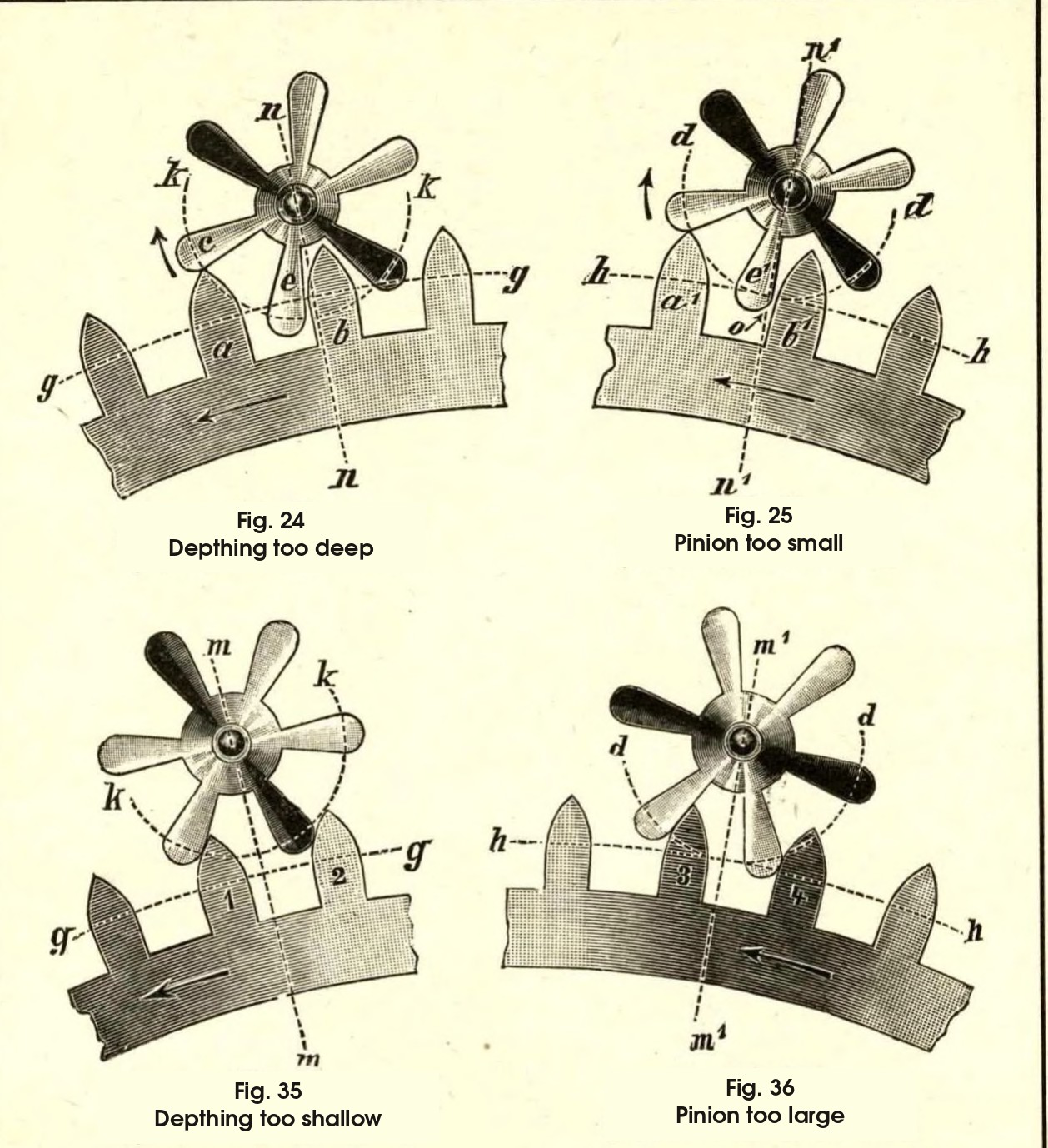
This distinction is crucial for the further assessment. The cause of a fault must be recognised before a correction is decided on. A pinion that is too small or too large may in theory make the depthing incorrect; if, however, the depthing can in practice be set smooth and free of butting, the rate need not suffer as a result. What remains decisive, therefore, is the interplay of depth of engagement, pinion size, tooth form and the running that can actually be felt.
Where the depthing can be seen, observation under the eyeglass supplements the sense of touch. If a direct visual check is not possible because of the construction of the movement, feeling through slowly becomes especially important. If in doubt, a depthing tool set to the centre distance can help to judge the meshing more precisely outside the movement.
Check first, then act
Backlash, depth of engagement, drop and butting describe different properties of a wheel and pinion. Anyone who equates them too hastily risks making a correction in the wrong place.
The reliable approach begins with feeling the depthing through slowly. Then the backlash, whether the wheels run true, individual wheel teeth, the pinion size and the condition of pivots and bearings are checked. Only when the symptom that can be felt has been assigned to an actual cause can one decide which remedy is technically justifiable.
The specific repair methods – such as correcting the centre distance, reworking or replacing a wheel, or fitting a suitable pinion – form a separate step. For the diagnosis, the first rule is: not every resistance is a depthing that is too deep, not all play means sufficient backlash, and not every jerk has the same cause.
In the next part, attention turns to the escape wheel and pallet fork. There we will again meet terms such as depth of engagement and drop, together with height adjustment, run to the banking and draw. The “drop” in the lever escapement refers to a different process from the free path between wheel and pinion dealt with here.