
This article was translated from German. Despite our care, some technical terms may be imprecise. The German version is authoritative.
Anyone who wants to understand a movement has to understand the escapement. It determines how the power of the going train is turned into controlled running.
This article opens a new series on the escapement and the regulating organ. It covers the ground from the classic escapements of the clock, through historical escapements for portable timepieces, to the detached lever escapement and a first look ahead at special designs after George Daniels.
What is the regulating organ in a movement?
The regulating organ is what actually measures time in a timepiece. It divides time into intervals that are as equal as possible, which is why in German it is also called the Zeitteiler, the “time divider”. The quality of the whole timepiece depends largely on its quality.
In pendulum clocks the pendulum performs this task, in portable timepieces the balance with its balance spring. The balance spring draws the balance back to its centre position again and again. In this way it replaces what gravity does for the pendulum.
A mechanical movement consists of the motive power, the going train, the escapement and the regulating organ. The first three supply the regulating organ with the power it needs to keep oscillating.
The task of the escapement in a movement
The escapement sits between the going train and the regulating organ. It does not release the turning of the escape wheel unchecked, but transmits the available power to the pendulum or balance in individual, recurring impulses.
At the same time it limits the running down of the going train. The regulating organ thus determines the rhythm in which the movement keeps running. The escapement therefore influences not only the transmission of power, but also the amplitude, the rate behaviour and the sensitivity to external influences.
The decisive question is how far the regulating organ can swing between two impulses with as little interference as possible. This gives rise to the basic distinction between the types of escapement.
Escapements in clocks: recoil, dead-beat, detached
In clocks with a pendulum, classical horology distinguishes between recoil, dead-beat and detached escapements.
In a recoil escapement the pendulum is noticeably influenced and driven back while the escapement is in engagement. This design is comparatively simple to construct, but can impair the regulating organ more strongly.
Dead-beat escapements reduce this recoil to frictional rest. The Graham escapement stands for this principle: the pendulum receives its impulse, while between the impulses the escapement works on a locking face.
Detached escapements go further. They are meant to let the pendulum swing as freely as possible in the supplementary arc and to confine the influence of the going train to a limited range around the centre position.
This reveals a fundamental aim of horology: the regulating organ should be connected to the movement only where impulse is needed. It should perform the remaining part of its oscillation with as little interference as possible.
Portable timepieces: from the verge to the detached lever escapement
In portable timepieces, too, the verge escapement stood at the beginning. Between 1500 and 1700 it characterised the early pocket watches and other small timepieces.
As the demands on timekeeping accuracy rose, its limits became more apparent. The strong recoil and the small amplitude of the balance, which with the verge escapement could hardly exceed 100 degrees, had an adverse effect on the rate.
A watch that is being worn is also exposed to movements and shocks. Depending on their direction and timing, they can speed up or slow down the regulating organ. Larger amplitudes of the balance increase its mean speed and so reduce its sensitivity to such external influences.
The cylinder escapement as a frictional rest escapement
Thomas Tompion and George Graham developed the cylinder escapement between about 1695 and 1720. It builds on the Graham escapement and belongs to the frictional rest escapements.
In this design the two pallets are replaced by the wall of a cylinder. A cut-out, the so-called passage, allows the rim of the cylinder escape wheel to pass through. As a result the balance can reach a considerably larger amplitude.
The mean amplitude of the balance in the cylinder escapement is about 270 degrees. Compared with the verge escapement, this was a considerable advance.
The cylinder escapement, however, is not a detached escapement. Frictional rest still acts during the supplementary arc. In prolonged service, oil that thickens or becomes dirty can increase the friction and cause the watch to lose.
Duplex escapement: a double wheel with advantages and disadvantages
The duplex escapement works with a double wheel. Long locking teeth and short impulse teeth have different tasks: the locking teeth do the locking, the shorter teeth give the impulse.
Impulse is given only at every second vibration of the balance. This design, however, brings particular demands with it. The escapement has a dead point and is therefore not self-starting.
At large amplitudes it can also “gallop”. Two impulses then occur during one vibration, so that the watch goes twice as fast. The duplex escapement was therefore made comparatively rarely and was soon largely superseded by the lever escapement.
The detached lever escapement: idea and basic principle
The detached lever escapement gives the regulating organ as much freedom as possible during the supplementary arc. In this phase the going train and escapement are not meant to influence the balance directly.
The balance does not swing completely freely, though: pivot friction, air resistance and the internal friction of the balance spring remain in effect. Compared with frictional rest escapements, however, the direct influence of the movement is clearly reduced.
Thomas Mudge developed the detached lever escapement in the mid-18th century. Between the escape wheel and the regulating organ sits a pallet fork with pallet stones. Transmission from the pallet fork to the balance takes place via the impulse pin and the notch of the fork.
So that the escapement works reliably under shocks, a guard pin and a safety roller are part of the design. They prevent the pallet fork from getting to the wrong side during the supplementary arc. In addition, the draw angle ensures that the pallet fork is held securely against its banking pin.
With an escaping angle at the balance of about 35 degrees, made up of unlocking and impulse, by far the greater part of the total arc remains as supplementary arc.
Why the detached lever escapement prevailed
Comparing the verge, cylinder and duplex escapements with the detached lever escapement reveals a common aim of development: the balance should be able to swing with as little disturbing influence from the going train as possible.
The detached lever escapement concentrates unlocking and impulse in short, defined sections of the oscillation. The balance can travel through the remaining supplementary arc largely according to its own oscillating behaviour.
With the cylinder and duplex escapements, by contrast, frictional rest remains an important influence. There, the condition of the oil in particular can change the rate behaviour.
The detached lever escapement, in the form widely used today, combines this extensive freedom of the balance with a robust design. It is precisely this combination of reliable impulse, secure locking and high suitability for everyday use that explains its great importance in mechanical wristwatches.
The development of the escapement did not end with the detached lever escapement, however. George Daniels describes the chronometer escapement as a detached single impulse escapement: the escape wheel gives its impulse directly to a roller on the balance staff, while the regulating organ can swing freely in the supplementary arc.
His co-axial escapement takes up the search for favourable conditions of force and friction, but follows its own constructional path. It works with two wheels lying one above the other and divides the impulses into a direct impulse to the balance and a further one via the pallet fork.
Outlook: from theory to the bench
This article clarifies the terms and the relationships between recoil, dead-beat and detached escapements in clocks and watches. At the same time it explains why the detached lever escapement became the defining principle of modern portable timepieces.
The series will now continue this subject in detail. It begins with depthing faults and escapement problems: backlash, depthing that is too deep or too shallow, rubbing, and the question of how faults can be identified systematically.
This is followed by the detached lever escapement in repair practice, where the focus is on depth of engagement, drop, run to the banking and draw. Later parts are devoted to the chronometer escapement and the co-axial escapement after George Daniels, and to the interplay of escapement, balance, balance spring and regulation.
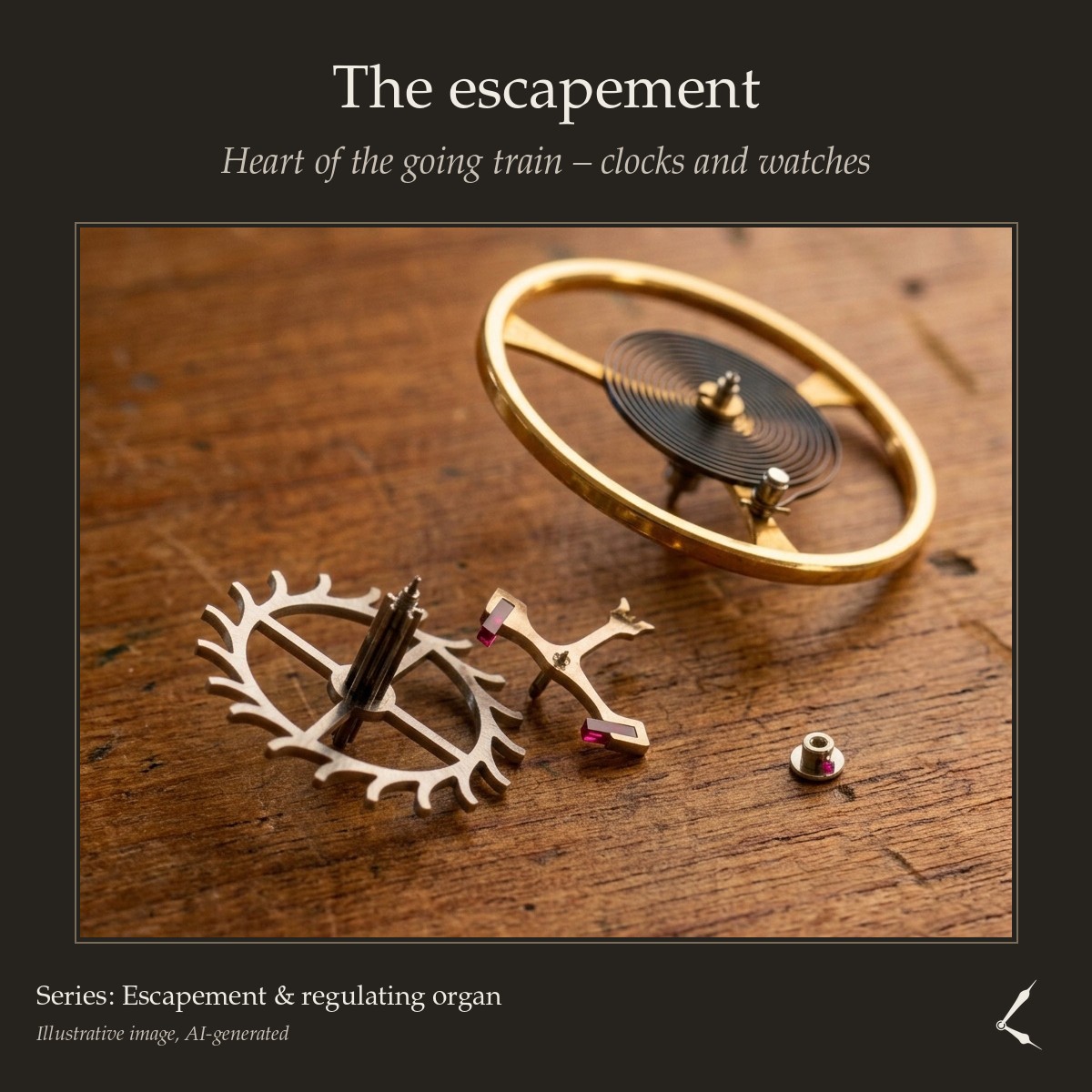
Featured image: symbolic image, created with AI.