This article was translated from German. Despite our care, some technical terms may be imprecise. The German version is authoritative.
Series: The bench
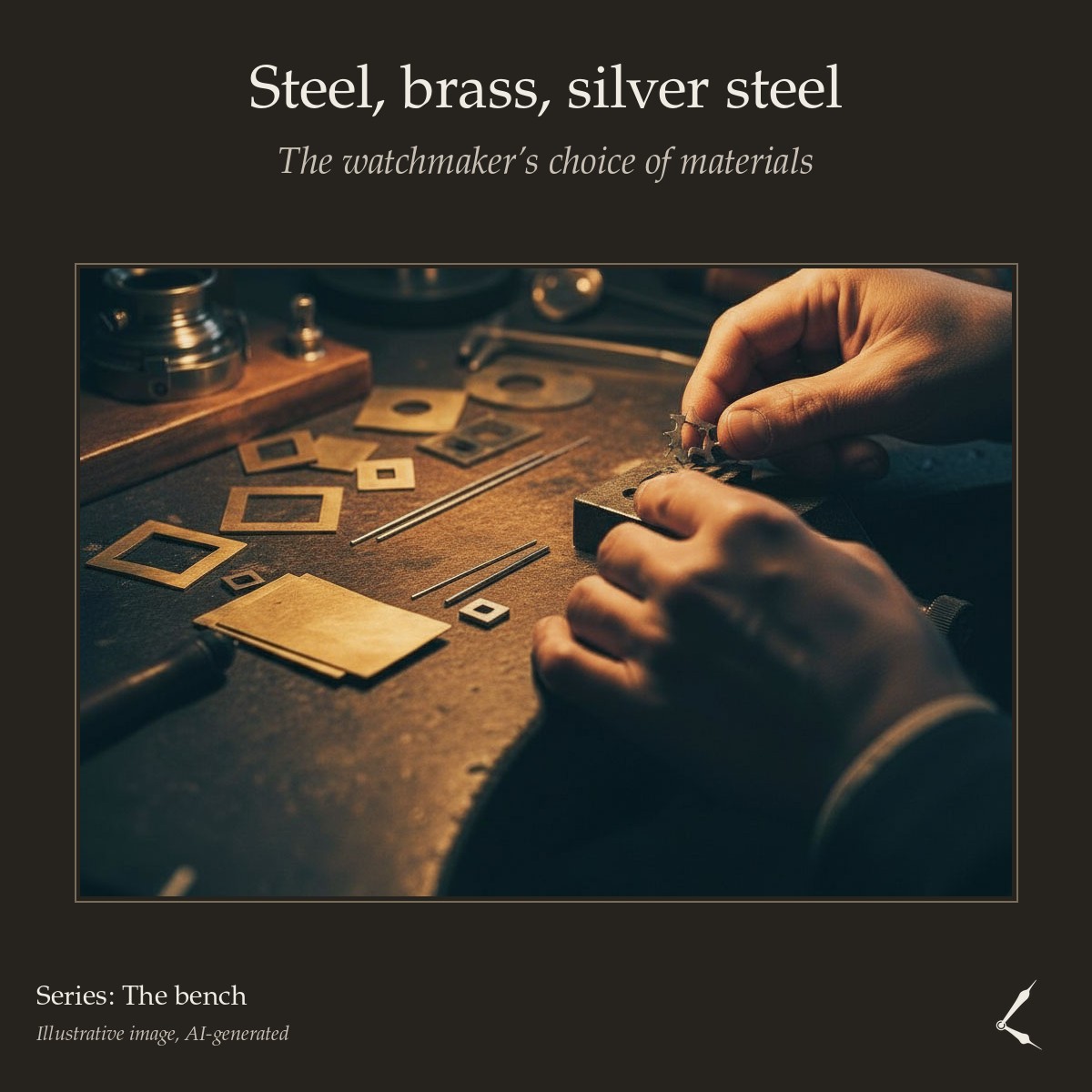
Anyone who thinks watchmaking only begins with the assembly of the movement is mistaken. The quality of a mechanical watch is decided long before that: in the materials store. Why do we use a specific brass alloy for main plates? Why do we reach for “silver steel” for arbors rather than a nail from the DIY store?
In this article we open our materials drawer. We look at why steel is not just steel and why a piece of brass sheet first has to be “baked” before it can be worked precisely.
1. The watchmaker’s gold: brass (CuZn39Pb3)
Next to steel, brass is the most important material in our workshop. But beware: brass is not just brass. An alloy that bends well is entirely unsuitable for cutting a wheel.
As a rule, the watchmaker uses CuZn39Pb3 (formerly often referred to as MS58 or “watch brass”). This alloy contains lead, which gives it excellent machinability – the chips break short and do not wind themselves around the cutter.
The decisive difference: hardness When buying, you must pay attention to the rolled condition:
- Half-hard sheet: Suitable for bending work (e.g. case making), but too soft for load-bearing parts.
- Hard-rolled sheet: The material of choice for wheels and main plates. It would break if bent, but it can be turned and milled excellently.
The professional tip: stress-relieving brass A mistake many beginners make: they saw off a piece of brass sheet and start milling straight away. The result? The part warps and goes “crooked”.
The solution: Rolling and cutting with the guillotine shears leave enormous internal stresses in brass sheet. To remove them, we lay the sheet on a hotplate (low setting). As an indicator, we put a scrap of paper on top. When the paper turns slightly brown, the sheet is “stress-relieved” and can be worked without warping.
2. Steel is not just steel
There are over 2,500 standardised steel grades. For us watchmakers, however, three categories above all are decisive, and they must be kept strictly apart.
A. The classic: silver steel (115CrV3)
When we make arbors, pinions or levers, we use hardenable steels. The best-known representative is “silver steel” (115CrV3).
- Why? In the soft state it is easy to work (sawing, filing, turning) and can then be hardened by heating (to cherry red, approx. 800 °C) and quenching in oil. After that it is glass-hard and is tempered, which brings it to approx. 60 HRC.
- The aim: Wear resistance. An unhardened arbor would wear in next to no time.
B. The economical one: free-cutting steel (e.g. 9 S20)
For parts that are not subject to high loads (e.g. pillars, simple screws or fixtures), we use free-cutting steels. Alloying elements such as sulphur and lead make sure that the chips break.
- The drawback: Because of their low carbon content, these steels are as a rule not hardenable. Anyone who tries to harden a balance staff made of free-cutting steel is in for a nasty surprise: it stays soft.
C. The trap: stainless steel (V2A / V4A)
Visually almost indistinguishable from silver steel, but a completely different world when it comes to machining.
- 1.4301: A classic stainless steel. It welds well, but for the watchmaker at the lathe it is a nightmare, because it is very difficult to machine (it “smears”).
- 1.4305: The better choice for us. It machines well, but it cannot be welded.
3. Why different materials at all? (Tribology)
Why do we make the main plate of brass and the arbor of steel? Why not steel on steel? The answer lies in tribology (the science of friction). In a movement there is often “mixed friction”, because there is no continuous rotation to build up a stable oil film.
If two identical materials rubbed against each other (e.g. a steel arbor in a steel hole), the risk of “seizing” would be high. Pairing different materials (friction partners) such as steel/brass or steel/ruby minimises wear and friction.
Practical conclusion
Before you next go to the lathe, check your material carefully:
- Is it the right steel for the purpose? (Does it need to be hardened?)
- Have I stress-relieved my brass sheet?
- Is the pairing of materials right for the bearing?
Precision does not begin with measuring, but with the choice of materials.
Further reading: The trained eye: the art of spotting a fault before it stops the watch
Featured image: illustrative image, created with AI.