
This article was translated from German. Despite our care, some technical terms may be imprecise. The German version is authoritative.
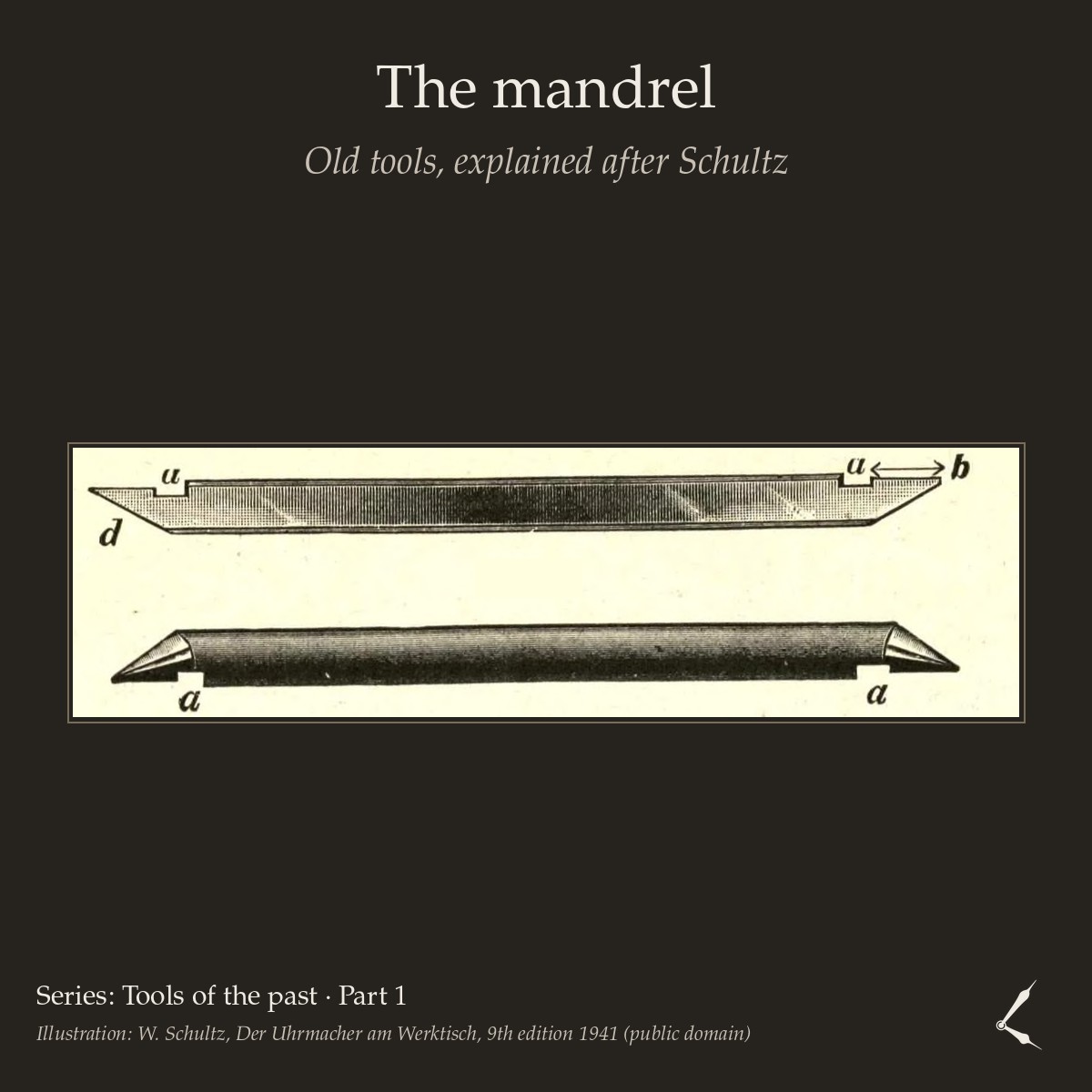
For Wilhelm Schultz the matter was clear: a watchmaker’s workshop without a mandrel could not be counted as “complete”. Not even the good watchmaker’s lathes of his day could fully replace it. The machine, called “burin fixe” in French, clamps a flat workpiece such as a plate onto a faceplate with three dogs. In this way recesses, countersinks and holes can be turned exactly true to the centre, for new work as well as for repairs.
How quickly the workshop changed is shown by the last edition of the book, in 1941. There the later editor added that the mandrel was no longer built as a machine in its own right and that one had to fall back on the corresponding attachment for the watchmaker’s lathe. Today it is met mainly as an antique watchmaker’s tool. What Schultz wrote about its use, however, applies to every faceplate and every compound slide.
First check: arbor, centring point, faceplate
According to Schultz, fine recesses are only possible on a machine in the best condition:
- The arbor runs without play and yet freely, and is generously oiled.
- The centring point runs perfectly true. If it does not, it is trued with the graver and finely ground. It can be moved without great effort, but must not wobble.
- The faceplate runs perfectly flat, and the three dogs are exactly the same height, so that the workpiece lies parallel to the plate.
Clamping correctly: the forgotten locking nuts
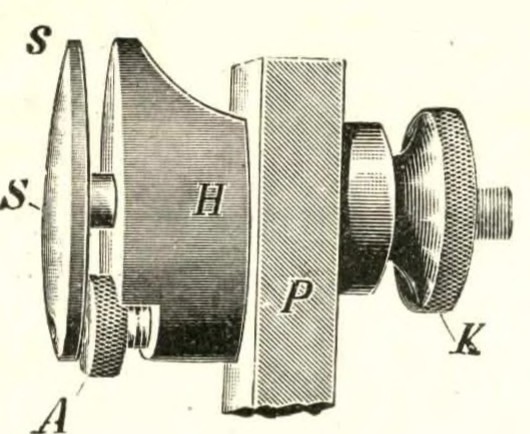
A common fault concerns the locking nuts at the rear end of the three dogs. Many workmen did not use them at all, writes Schultz. Without them the dog jaw is pulled askew when it is screwed tight, the workpiece never sits really firmly, and the clamping screw suffers too.
His sequence for clamping a main plate:
- Set the plate on the centring point and tighten the three nuts only lightly.
- If necessary, true the plate.
- Screw the three locking nuts forward so that they support the jaw at the rear.
- Only then tighten the clamping screw behind the faceplate firmly.
When it is tightened, only the front part of the jaw can then give. It stays flat on the plate, and the workpiece sits immovably.
The slide rest: square, not too free, not too stiff
The tool holder is just as important. The longitudinal slide and the cross slide must be exactly square to each other, otherwise a surface turned flat becomes convex or concave, and a hole turned right through becomes narrower or wider at the back than at the front. Schultz’s test: lightly face a brass plate from the centre to the left, then take the graver across the centre to the right without moving the longitudinal slide. It must touch the surface lightly all the way. If it moves away, the surface was convex; if it bites more and more, it was concave. The correction is made by shifting the upper slide a little with light blows of a wooden mallet and repeating the test.
How freely the slides move matters too. If they run too freely, the graver begins to “chatter”; if they run too stiffly, the surface shows a ring at every turn of the handle. Schultz strongly recommended an adjustable tool post: it takes gravers with thin and thick shanks, and even a graver that has been ground back many times can always be set exactly to the centre again.
The graver: shape, hardness and a shine in rainbow colours
As basic equipment Schultz names two double gravers that cut to the right at one end and to the left at the other, one ground more slender and one blunter. Recesses filed into the side ensure that the cutting edge keeps its direction even after much resharpening. In addition there are two fine gravers for turning right through, which must not be tempered harder than dark blue, otherwise they break too easily. For turning a groove the graver must be narrower than the groove.
For a smooth surface he lists three things: turn the handle quickly and evenly and never stop in between, feed the graver sideways very slowly, and work with an almost pointed graver with a very narrow cutting edge. The pre-ground graver is drawn over a fine oilstone at most twice under light pressure; more does harm. Then the edges are passed over hardwood with diamantine, and the graver is cleaned with pith. According to Schultz, a graver prepared in this way turns so well that good brass shimmers in rainbow colours on the surface.
Three further points complete this:
- Cast brass should only be worked once the hard casting skin has been removed. The moulding sand in the pores quickly blunts any cutting edge.
- The harder the material, the blunter the angle of the cutting face. What cuts in brass only scrapes in steel.
- Height of the graver: for recesses it stands a fraction above the centre; when turning from the outside towards the centre, for instance on a boss that is left standing, a little below it.
Conclusion
The mandrel has largely disappeared from workshops, its lessons have not. Anyone who uses a faceplate or a compound slide checks running true and squareness, clamps with support rather than force and keeps the graver sharp. In the end, for Schultz turning was above all one thing: “Practice, nothing but practice!” More about workshop order and working speed can be found in the first part of the series “From the 1902 training workshop”, The art of working quickly and well. Tools for today’s bench can be found in our category Watchmaker’s tools.
Source: Wilhelm Schultz, Der Uhrmacher am Werktisch, 9th edition, revised by Fr. A. Kames, Berlin 1941, pp. 115–122 (§§ 220–244). Schultz’s statements already appear in the 7th edition of 1924. The note that the machine was no longer built comes from the 1941 revision and is given here in our own words. Quotations translated from the German by Ernst Westphal e.K.