
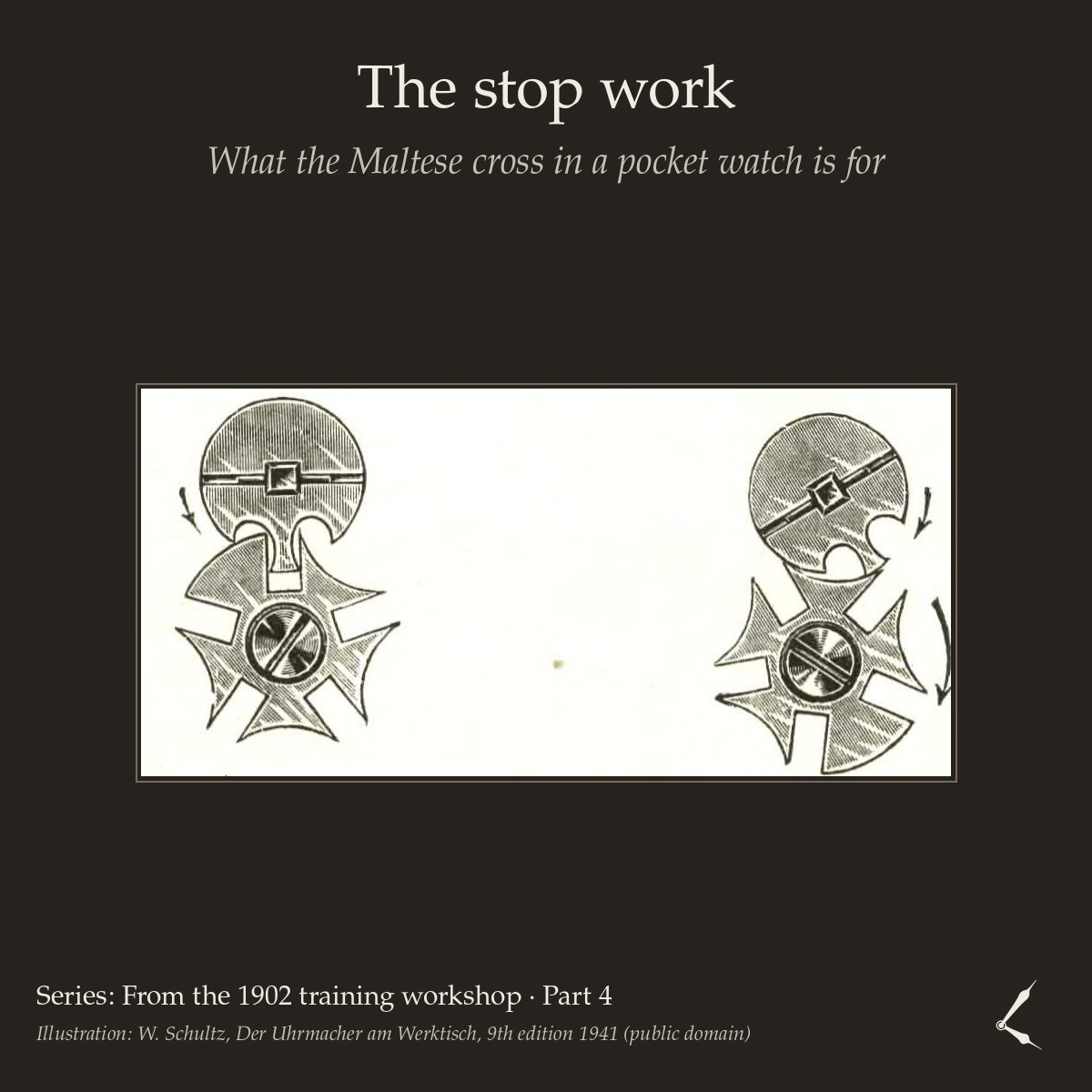
This article was translated from German. Despite our care, some technical terms may be imprecise. The German version is authoritative.
A mainspring does not deliver its force evenly. The article on the mainspring gave Schultz’s rule of thumb: as the spring runs down, the barrel should make six full turns. According to Schultz, one winds on one to one and a half coils before setting the stop finger in the let-down position, because the force falls off sharply in the last coils. That is exactly what the stop work is for: it limits the number of turns, so that the spring is neither wound fully up to the stop nor fully let down.
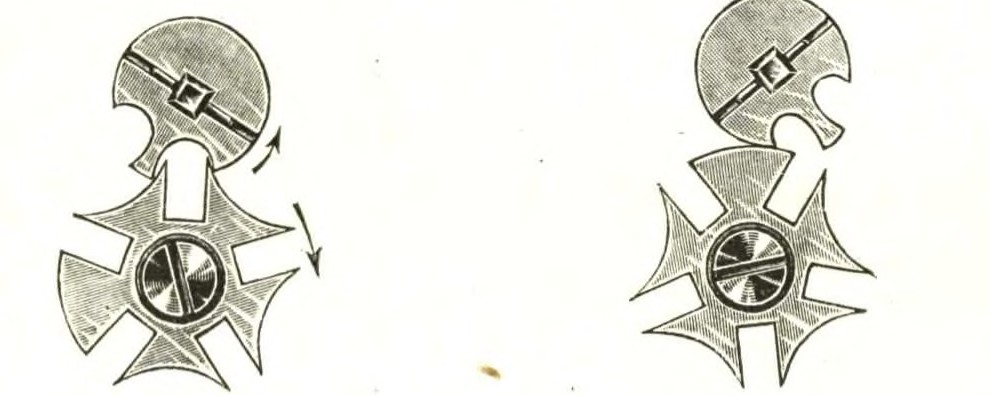
Even in Schultz’s day, the stop work in the narrower sense meant the Maltese cross stop work. A stop finger sits on the square of the barrel arbor, and a stop wheel with five teeth on a boss in the barrel cover. At each turn the finger moves the cross on by one space until, at the end, it meets the full tooth and stops the movement. In older editions, by the way, the parts are still called “Stellzahn” and “Stellkreuz”.
Nine faults that Schultz knew
A faultless stop work has a finger and a cross of the right size and shape and the right distance between them. Schultz lists in nine points what can go wrong, summarised here:
- Depthing too shallow, although both parts have the right shape.
- Finger too small or too short: the stop work can “overrun” even with moderate winding.
- Cut-outs beside the finger too large, or conversely too small, and sharp tooth corners on the cross.
- Recess of the cross or head of the shoulder screw not round: the cross binds at times.
- Cross wobbles, because the boss is too high, too thin or crushed, or the screw head is too small. A thin finger can jam underneath it.
- Recess for the finger in the cover too shallow: the barrel binds, possibly until the watch stops.
- Round part of the finger too large or rough, so that it jams against the teeth of the wheel.
The check in a few minutes
Schultz checked every stop work in a fixed order:
- Cross alone: it must turn freely without wobbling. Tighten the shoulder screw firmly first; this is often forgotten when reassembling. If the cross binds, put a little oilstone slurry between the screw head and the recess, take hold of a space with the pegwood and turn until it runs freely. This way material is ground away only where it binds.
- With the finger: the barrel must still run freely with the finger fitted. If not, the recess in the cover must be turned deeper or the finger ground a little thinner from below.
- Passage through every space: turn the barrel twice right round in each direction, that is four times. While doing so, press the cross with the tip of the pegwood once away from the finger and once against it, to provoke the faults of a finger that is too small and cut-outs that are too wide.
- Overrunning: when letting the spring down and winding it, press the cross against the finger with a little pressure. At the end, the finger must meet the full tooth just as in the faultless stop work.
Only when all the tests have been passed is the stop work in order. If only one of the five teeth is too short, attempts are sometimes made to stretch it with chisel blows. According to Schultz, however, it is usually better to make a new cross straight away.
Making new parts
For a new stop finger, Schultz recommends choosing a blank hardly larger than the finished part, because turning it round is the most laborious work. The square hole is filed open evenly on all sides and finally finished with a slightly tapered square steel drift, struck alternately from above and below. Because the projecting finger does not allow a full turn, it is turned round not with the flywheel but with the old bow, on a specially made square arbor. It is then filed to length and width with fine files, the passage is checked again four times, and it is hardened, tempered to light blue and cleanly ground.
On the cross, each tooth is filed individually to suit the finger and lightly rounded at the tip, then hardened and tempered like the finger. If the boss has been damaged by winding too hard, a new recess is made exactly opposite the old one. This still leaves material on the right and left for two more. Schultz’s advice for the inexperienced: rather turn the small boss a little larger and afterwards broach the hole in the cross to fit.
Conclusion
The Maltese cross stop work is a small part with a great effect on the rate. It keeps the mainspring in its even range when the finger, cross and recesses are right. Anyone who checks it with Schultz’s four tests will find the typical faults before the watch stops. How the ratchet and click holds the wound-up power is described in the previous part of the series. In the next part we turn to the lever escapement: depth of engagement, drop and run to the banking.
Source: Wilhelm Schultz, Der Uhrmacher am Werktisch, 9th edition, revised by Fr. A. Kames, Berlin 1941, pp. 232–239 (§§ 530–552) and p. 247 (§ 575). All passages used appear in the 7th edition of 1924 and are by Schultz.